-
Title
-
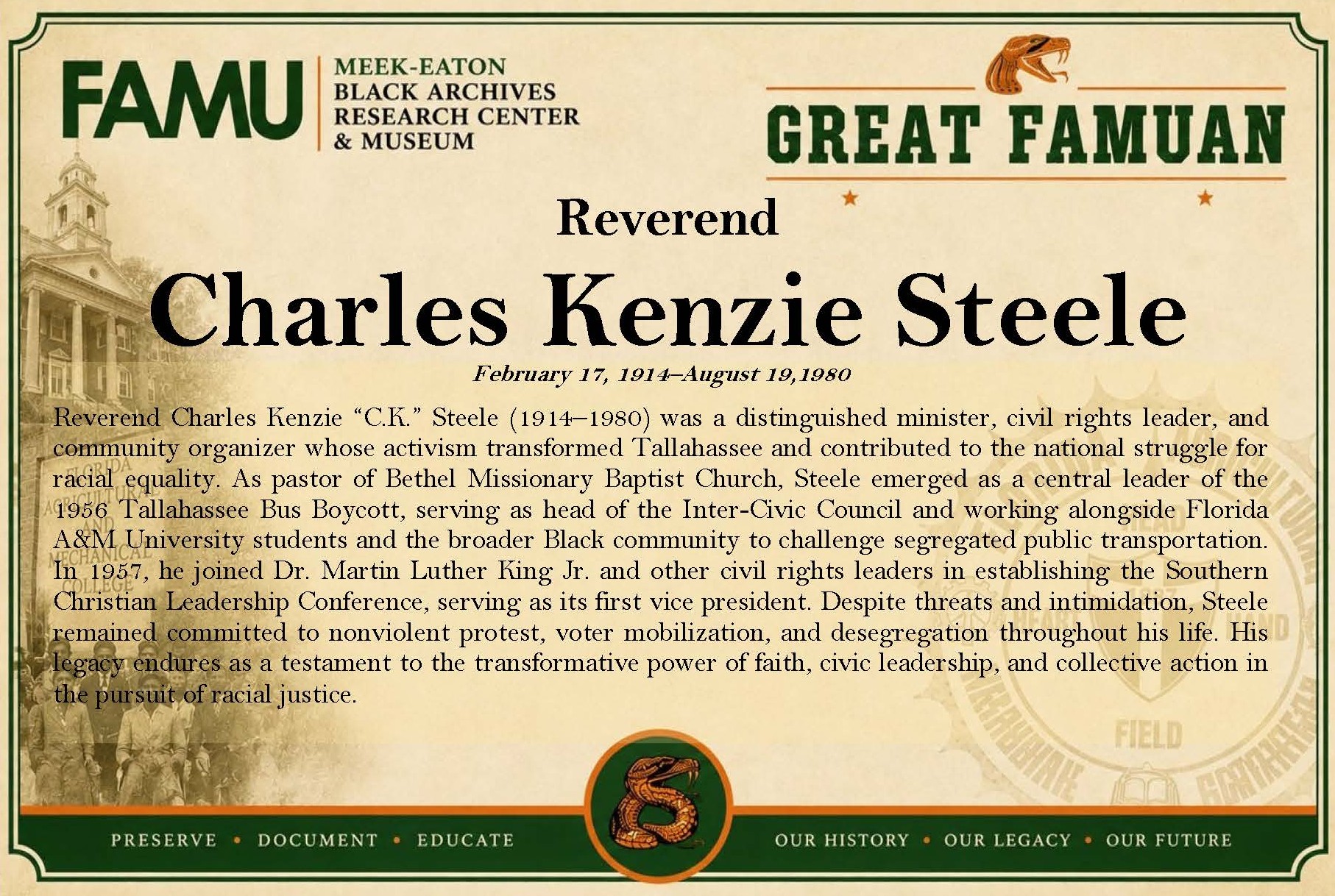
Reverend Charles Kenzie Steele
-
Alternative Title
-
CK Steele
-
Birth Date
-
February 17, 1914
-
Transition Date
-
August 19, 1980
-
Category
-
Religion
-
Affiliation to FAMU
-
Activist
-
Life at FAMU
-
Reverend Charles Kenzie “C.K.” Steele occupies an important place in the history of Florida A&M University through his close association with the student-led activism that helped shape the Tallahassee Civil Rights Movement. Although Steele was not a member of the University’s faculty or administration, his leadership as pastor of Bethel Missionary Baptist Church and as a prominent community organizer placed him in direct partnership with Florida A&M students whose activism challenged racial segregation in Tallahassee during the 1950s and 1960s.
This relationship became especially significant during the 1956 Tallahassee Bus Boycott. The movement emerged after Florida A&M University students Wilhelmina Jakes and Carrie Patterson were arrested following their challenge to segregated seating practices on the city’s public transportation system. Their actions galvanized students and members of Tallahassee’s African American community, leading to an organized boycott of the municipal bus system. Steele became one of the principal leaders of the movement and helped establish the Inter-Civic Council, which coordinated the community’s response to segregated transportation.
Through the Inter-Civic Council, Steele worked alongside students, clergy, educators, professionals, and community members to sustain the boycott and advocate for the desegregation of public transportation. The movement demonstrated the important relationship between student activism and established Black civic and religious institutions. Florida A&M students provided a critical catalyst for protest, while Steele and other community leaders helped develop the organizational infrastructure necessary to transform student resistance into sustained collective action.
Steele’s relationship with Florida A&M students continued within the broader struggle for civil rights in Tallahassee. As students increasingly challenged segregation and racial discrimination, Black churches and community organizations provided important networks of support, meeting spaces, moral leadership, and opportunities for intergenerational collaboration. Steele emerged as a significant bridge between student activists and the wider African American community, helping connect local demonstrations to an expanding regional and national movement for racial equality.
His association with Florida A&M consequently represents an important chapter in the University’s civil rights history. The collaboration between Steele, student activists, Black churches, and Tallahassee residents demonstrates how historically Black colleges and universities functioned within broader communities of resistance during the Civil Rights era. Through this relationship, Florida A&M students contributed to a local movement whose influence extended beyond the University and helped position Tallahassee within the larger history of the African American freedom struggle.
Reverend C.K. Steele’s connection to Florida A&M is therefore best understood through a shared tradition of civic engagement and collective action. His leadership helped amplify the courage of students who challenged segregation and provided an organizational framework through which their actions could become part of a sustained community movement. His legacy remains inseparable from the history of FAMU student activism and from the generations of students whose pursuit of justice contributed to the transformation of Tallahassee and the American South.
-
Life Bio
-
Distinguished Baptist minister, civil rights leader, and community organizer whose leadership helped transform the struggle for racial equality in Tallahassee and contributed to the development of the national Civil Rights Movement. Through Christian ministry, nonviolent protest, community organization, and civic engagement, Steele became one of Florida’s most consequential twentieth-century civil rights leaders.
Born in Gary, West Virginia, Steele pursued a vocation in Christian ministry that ultimately brought him to Tallahassee, Florida. In 1952, he became pastor of Bethel Missionary Baptist Church, where he developed a ministry that connected Christian faith with social responsibility. Under his leadership, Bethel became not only an influential religious institution but also an important center of civic engagement. Steele believed that religious leadership required active concern for the social and political conditions affecting African Americans and used the moral authority of the church to advocate for human dignity, citizenship, and racial equality.
Steele achieved statewide and national prominence through his leadership during the 1956 Tallahassee Bus Boycott. As president of the newly organized Inter-Civic Council, he helped coordinate the African American community’s response to segregated public transportation. The council organized alternative transportation, encouraged participation in the boycott, coordinated community strategy, and sustained resistance despite considerable social and political opposition. The campaign became one of Florida’s most significant early challenges to Jim Crow segregation and established Steele as an influential voice within the emerging Southern freedom movement.
His work in Tallahassee connected him with a growing network of ministers and activists seeking to coordinate civil rights campaigns throughout the South. In 1957, Steele joined Dr. Martin Luther King Jr. and other prominent Black religious leaders in establishing the Southern Christian Leadership Conference. Serving as the organization’s first vice president, Steele helped connect locally organized struggles against segregation to a broader regional movement based upon nonviolent direct action, religious leadership, and community mobilization.
Throughout the following decades, Steele remained an active advocate for civil and human rights. He participated in demonstrations, challenged segregation in public accommodations, supported voter-registration efforts, encouraged political participation, and worked with local and national civil rights organizations. His ministry reflected the historic role of the Black church as a center of spiritual life, social organization, leadership development, and resistance to racial injustice.
Steele’s activism was undertaken at considerable personal risk. Like many civil rights leaders of his generation, he confronted intimidation, threats, and hostility because of his public opposition to segregation. Despite these pressures, he remained committed to nonviolent protest and community organization, continuing to advocate for equality while providing pastoral and civic leadership to the people he served.
Steele remained pastor of Bethel Missionary Baptist Church and a prominent voice for social justice until his death on August 19, 1980. His decades of leadership established an enduring legacy within Tallahassee, Florida, and the national Civil Rights Movement. His contributions have been commemorated throughout the city, most notably through the C.K. Steele Bus Plaza, whose association with Tallahassee’s transportation system carries particular historical significance given his leadership in the campaign against segregated public transportation.
Reverend Charles Kenzie Steele’s life represents the powerful intersection of faith, moral leadership, and organized social action. As a minister, president of the Inter-Civic Council, founding leader and first vice president of the Southern Christian Leadership Conference, and persistent advocate for civil rights, he helped transform local resistance into sustained collective action. His legacy demonstrates the indispensable role of Black religious institutions and community leadership in dismantling segregation and expanding the possibilities of American citizenship. Steele remains an enduring figure in the history of Florida and the broader African American freedom struggle, remembered for his courage, disciplined leadership, and lifelong commitment to equality and justice.
-
Artifact Dimensions
-
L x W: 21.25 x 17.25in (53.97 x 43.82cm)
-
Medium
-
Photograph, dark wood frame
-
Provenance
-
Mrs. Carter B. Carnegie
-
Rights
-
All rights reserved. The use of any part of these objects and photographs transmitted in any form by any means, electronic, mechanical, photocopying, recording, or otherwise, or stored in a retrieval system without the prior written consent of Meek-Eaton Black Archives is an infringement of the copyright law.
-
Rights Holder
-
Meek - Eaton Southeastern Regional Black Archives Research Center and Museum