-
Title
-
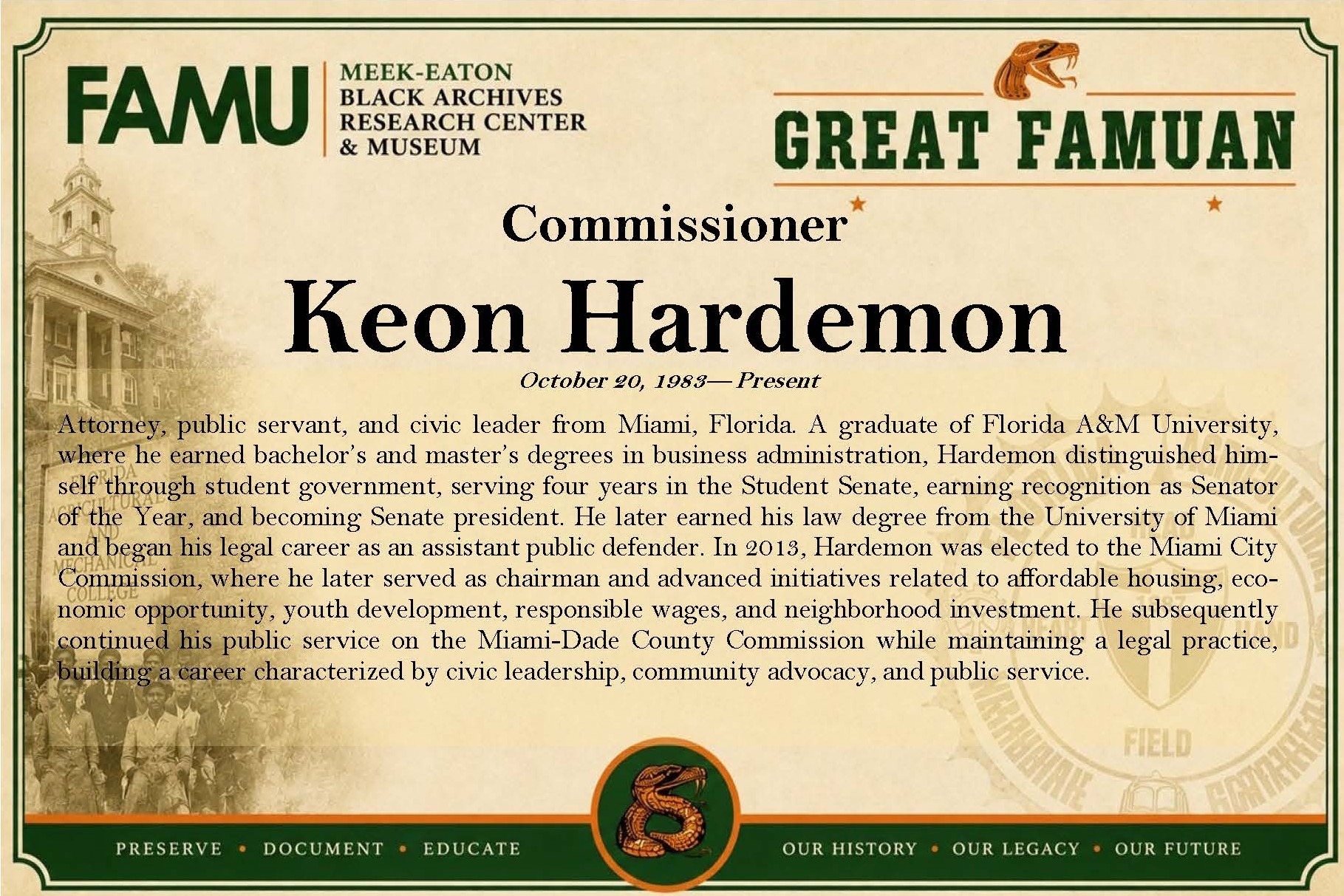
Commissioner Keon Hardemon
-
Alternative Title
-
Keon Hardemon
-
Birth Date
-
October 20, 1983
-
Category
-
Civil Service
-
Affiliation to FAMU
-
Alumni
-
Life at FAMU
-
Distinguished Florida A&M University alumnus Keon Hardemon’s collegiate years were characterized by academic achievement, student governance, organizational leadership, cultural participation, and sustained engagement in campus life. A native of Miami, Florida, Hardemon attended Florida A&M University, where he earned both bachelor’s and master’s degrees in business administration. His education in business provided a foundation in management, finance, administration, and organizational decision-making, while his extensive extracurricular involvement afforded him practical opportunities to develop the leadership skills that would later become central to his professional career in law and public service.
Hardemon became particularly active in the governance of the University through his service in the Florida A&M University Student Senate. During four years in the Senate, he participated in the legislative and representative processes of student government, gaining experience in budgeting, policy deliberation, institutional advocacy, and constituent representation. His service earned him recognition as Senator of the Year, reflecting his growing prominence as a student leader and his sustained involvement in matters affecting the student body.
Hardemon subsequently rose to the presidency of the Student Senate, one of the principal leadership positions within FAMU’s Student Government Association. As Senate president, he assumed responsibility for helping oversee a multimillion-dollar student government budget and participated in deliberations concerning the allocation and stewardship of student resources. The position required collaboration with fellow student leaders and University administrators while providing Hardemon with substantive experience in legislative leadership, fiscal oversight, negotiation, and institutional governance. These responsibilities anticipated many of the functions he would later encounter as an attorney and elected public official.
His influence in student government extended beyond the Florida A&M campus. Hardemon served as chair of the Florida Student Association’s Council of State University Senate Presidents, connecting his leadership at FAMU with the broader system of public higher education in Florida. Through this position, he engaged with student-government leaders from other state universities and participated in discussions concerning student representation and higher-education governance. The experience expanded his sphere of leadership from an individual university community to a statewide network of student representatives.
Hardemon’s FAMU experience was also distinguished by meaningful participation in organizations beyond student government. He became a member of the Beta Nu Chapter of Alpha Phi Alpha Fraternity, Incorporated, joining a historic collegiate fraternity whose traditions emphasize scholarship, leadership, service, and civic engagement. His fraternity affiliation complemented his work in student government and situated him within another important network of campus leadership, fellowship, and service.
An equally significant dimension of Hardemon’s collegiate experience was his active participation in the FAMU Strikers. Hardemon was not simply associated with the organization through an administrative position; he was an active member and performer with the dance troupe, participating directly in the cultural and performance traditions for which the Strikers became known. His involvement demonstrates an important dimension of his FAMU experience beyond academics and formal governance—one rooted in artistic expression, performance, fellowship, and the cultural life of the University.
In addition to performing with the Strikers, Hardemon served two terms as the organization’s financial custodian. This dual role is particularly noteworthy. As both a performer and organizational officer, he contributed to the Strikers from the stage as well as through the administrative work necessary to sustain the organization. His responsibilities as financial custodian allowed him to apply his developing knowledge of fiscal stewardship, accountability, and organizational management while remaining actively engaged in the troupe’s performances and activities.
The Strikers therefore occupied a distinctive place within Hardemon’s broader collegiate development. Dance and performance required discipline, preparation, collaboration, creativity, and collective responsibility—qualities that complemented the administrative and political skills he cultivated through student government. His participation illustrates how leadership development at Florida A&M University frequently occurred across multiple spaces: classrooms, student-government chambers, fraternity life, cultural organizations, and performance traditions.
During his collegiate years, Hardemon simultaneously participated in student governance, statewide student leadership, fraternity life, organizational administration, and cultural performance. Together, these activities reveal a student experience defined not by a single leadership position but by engagement across multiple dimensions of university life. His work with the Strikers is especially important to this narrative because it demonstrates that his contribution to campus life was not limited to governance or administration. He was also an active participant in the creative and cultural community that has long distinguished the Florida A&M student experience.
Hardemon’s academic preparation through Florida A&M University’s business program complemented these practical experiences. Principles of management, finance, organizational structure, and decision-making encountered through his studies could be applied directly within student organizations and governance. His responsibilities for budgets and organizational finances provided opportunities to translate classroom preparation into practical institutional leadership, while his participation as a performer reinforced the importance of teamwork, discipline, preparation, and collective achievement.
His years at Florida A&M therefore represent an important formative period in the development of his public identity. His progression from student senator to Senate president, recognition as Senator of the Year, statewide leadership through the Florida Student Association, membership in the Beta Nu Chapter of Alpha Phi Alpha Fraternity, Incorporated, and active membership and performance with the FAMU Strikers collectively demonstrate the breadth of his engagement with the University community.
These experiences also place Hardemon within Florida A&M University’s longstanding tradition of cultivating leadership beyond the classroom. Throughout its history, FAMU has educated generations of professionals and public servants while providing students with opportunities to develop through student government, fraternities and sororities, cultural and performing organizations, professional associations, and other forms of campus engagement. Such organizations have historically served as important environments for developing organizational skills, professional networks, cultural expression, institutional responsibility, and traditions of service.
Hardemon’s collegiate trajectory illustrates this broader educational function. His formal studies provided academic preparation in business and administration, while student government and organizational service offered practical laboratories for leadership. His participation with the Strikers added another dimension to that education, demonstrating how performance and cultural engagement could coexist with—and contribute to—the development of leadership, discipline, collaboration, and institutional identity.
The significance of Hardemon’s FAMU experience is therefore found at the intersection of scholarship, governance, organizational leadership, cultural expression, and service. Before entering the legal profession or holding elected public office, he was already participating in representative institutions, managing organizational resources, performing as part of a collaborative cultural organization, and assuming leadership responsibilities within a complex university environment.
Keon Hardemon’s relationship with Florida A&M University consequently extends well beyond his status as a graduate. FAMU served as an important environment for his intellectual, cultural, organizational, and leadership development. From his academic studies in business administration to the Student Senate, the Florida Student Association, Alpha Phi Alpha Fraternity, Incorporated, and his active membership and performance with the FAMU Strikers, Hardemon participated broadly in the institutional and cultural life of the University.
His journey from student leader and performer to attorney and public servant represents a contemporary continuation of Florida A&M University’s tradition of preparing graduates for professional and civic responsibility. The breadth of his involvement at FAMU—spanning academics, student government, statewide representation, fraternity life, organizational stewardship, and performance—provides important context for understanding his subsequent trajectory and the enduring role of Florida A&M University in his development.
-
Life Bio
-
Attorney, public servant, and community leader whose professional career has encompassed criminal defense, private legal practice, municipal government, county government, and civic advocacy. A native of Miami, Florida, Hardemon has built a career rooted in South Florida and shaped by sustained engagement with the legal, economic, and social issues affecting urban communities. His progression from attorney to elected official reflects a professional trajectory in which legal training and public administration have intersected with community-centered leadership.
Following his education in business administration, Hardemon pursued the study of law at the University of Miami School of Law. His legal education provided professional preparation in statutory and constitutional interpretation, advocacy, legal research, negotiation, and the institutional operation of the justice system. Upon earning his law degree, Hardemon entered public service as an assistant public defender, representing individuals within the criminal justice system who otherwise might not have possessed the financial resources necessary to secure private counsel.
Service as a public defender placed Hardemon within one of the most consequential areas of public law. The responsibility of representing indigent defendants requires attorneys to navigate the intersection of constitutional protections, criminal procedure, individual rights, and governmental authority. Through this work, Hardemon gained direct experience with the practical operation of the justice system and with the circumstances confronting individuals and families affected by criminal proceedings. His early legal career thus established a professional foundation grounded in advocacy and public representation.
Hardemon subsequently expanded his professional work through private legal practice. As an attorney operating his own law practice, he continued to develop experience in legal advocacy while establishing an independent professional presence within South Florida. His work in law remained an important component of his professional identity as his career increasingly moved toward elected public service.
In 2013, Hardemon was elected to the Miami City Commission, marking a significant transition from legal advocacy to municipal governance. His election placed him within the legislative body responsible for addressing many of the immediate issues affecting residents of a major American city, including economic development, housing, municipal services, neighborhood investment, infrastructure, business activity, and the allocation of public resources.
Hardemon’s service on the Miami City Commission was particularly significant because local government often represents the level of government with which residents interact most directly. Decisions concerning housing, development, public spaces, transportation, employment initiatives, neighborhood services, and economic investment can have immediate consequences for communities. His role therefore required engagement not only with legislation and municipal administration but also with residents, businesses, nonprofit organizations, developers, and other stakeholders whose interests could converge or conflict within the policymaking process.
During his municipal career, Hardemon advanced initiatives associated with responsible wages, affordable housing, youth development, small-business growth, employment opportunities, and investment in underserved communities. These areas of emphasis reflected a broader concern with economic mobility and the capacity of residents to benefit from the development occurring within their neighborhoods. His work addressed questions central to the governance of rapidly changing urban communities: how economic development can be encouraged while maintaining opportunities for longtime residents, how housing can remain accessible amid rising costs, and how public policy can strengthen pathways to employment and entrepreneurship.
Hardemon later served as chairman of the Miami City Commission. The chairmanship represented an expansion of his responsibilities beyond the representation of an individual district. Leadership of a legislative body requires the management of deliberative processes, coordination among elected colleagues, and engagement with a broad range of municipal priorities. His service in this capacity further developed the governmental and administrative dimensions of his career.
His work concerning affordable housing and neighborhood development was situated within the larger economic transformation of Miami. Like many rapidly growing metropolitan areas, South Florida has confronted persistent questions involving housing affordability, redevelopment, economic inequality, displacement, and equitable access to opportunity. Within this environment, Hardemon’s emphasis on housing, employment, wages, youth services, and small businesses reflected an effort to address the relationship between economic development and community stability.
Youth development likewise formed an important dimension of his public-service agenda. Programs directed toward young people can function as long-term investments in community well-being by expanding access to educational enrichment, employment experience, mentorship, recreation, and constructive civic engagement. Hardemon’s attention to youth programming complemented his broader emphasis on employment and economic opportunity by recognizing that sustainable community development depends upon investments in future generations as well as immediate economic concerns.
His advocacy for small businesses similarly reflected the important role of local entrepreneurship in neighborhood economies. Small and locally owned enterprises can provide employment, circulate resources within communities, and contribute to the social and commercial character of neighborhoods. Public policies affecting contracting, development, wages, and business opportunities therefore became part of the broader economic context within which Hardemon exercised municipal leadership.
After his service with the City of Miami, Hardemon continued his career in elected government as a Miami-Dade County commissioner. His movement into county government expanded the geographic and institutional scope of his responsibilities. Miami-Dade County encompasses numerous municipalities and unincorporated communities, requiring county officials to engage with complex regional issues that extend beyond the jurisdiction of any single city.
County service consequently placed Hardemon within a governmental structure responsible for addressing issues of metropolitan significance. His experience in municipal government provided a foundation for engaging with policy questions at this broader level, while his legal background continued to inform his understanding of governmental authority, legislation, and public administration.
Throughout his professional career, Hardemon has maintained an identity shaped by both law and public service. These fields are closely interconnected: attorneys interpret and navigate legal institutions, while elected officials participate in developing the policies and governmental structures within which those institutions operate. His experience in both arenas has provided him with perspectives derived from legal advocacy as well as legislative and administrative decision-making.
Hardemon’s career also illustrates the progression of leadership from direct representation to institutional governance. As an assistant public defender, his professional responsibility centered upon representing individual clients. As a municipal commissioner, his responsibilities expanded to the representation of communities and participation in citywide policymaking. County government further broadened that sphere of responsibility to regional concerns affecting a large and diverse metropolitan population.
Across these roles, Hardemon’s professional record has remained closely connected to Miami and its surrounding communities. His legal practice, municipal service, county leadership, and community engagement have placed him within ongoing discussions concerning economic opportunity, housing, employment, neighborhood development, youth advancement, and the responsibilities of local government.
Keon Hardemon’s professional biography ultimately reflects a career situated at the intersection of law, civic leadership, and community development. From representing clients within the justice system to participating in municipal and county governance, he has occupied positions requiring advocacy, negotiation, fiscal stewardship, and public accountability. His professional trajectory demonstrates how legal training can intersect with elected service to address the complex challenges facing contemporary urban communities.
Through his work as an attorney, assistant public defender, city commissioner, commission chairman, county commissioner, and community advocate, Hardemon has established a multifaceted career in public life. His continuing engagement with the communities of South Florida reflects a broader tradition of civic leadership in which professional achievement is accompanied by participation in the institutions responsible for shaping community life. His career stands as an example of the relationship among professional preparation, representative leadership, and sustained public service.
-
Artifact Dimensions
-
L x W: 25.38 x 21.38in (64.45 x 54.29cm)
-
Medium
-
Photograph, gold-painted frame with carved style detailing.
-
Rights
-
All rights reserved. The use of any part of these objects and photographs transmitted in any form by any means, electronic, mechanical, photocopying, recording, or otherwise, or stored in a retrieval system without the prior written consent of Meek-Eaton Black Archives is an infringement of the copyright law.
-
Rights Holder
-
Meek - Eaton Southeastern Regional Black Archives Research Center and Museum