-
Title
-
James R. Ford
-
Alternative Title
-
James Ford
-
Birth Date
-
December 1, 1925
-
Transition Date
-
October 11, 2017
-
Affiliation to FAMU
-
Alumni
-
Life at FAMU
-
Distinguished Florida A&M University alumnus, educator, civic leader, and public servant whose life reflected the University’s longstanding tradition of preparing African American professionals for leadership and service. A native of Tallahassee, Florida, Ford came of age during an era when racial segregation restricted educational, professional, political, and social opportunities for African Americans throughout the South. Within this environment, Florida A&M University served as an important center of Black intellectual life and professional preparation, providing generations of students with educational opportunities at a time when segregation excluded them from many other institutions of higher learning in Florida.
Following military service in the United States Navy during World War II, Ford pursued higher education at Florida A&M. He earned a Bachelor of Science degree from Florida A&M College and later continued his graduate education at the institution, earning a master’s degree in education. His studies prepared him for a career devoted to teaching, educational administration, and community leadership. His educational development at FAMU placed him within the University’s influential tradition of preparing Black educators who would serve schools and communities throughout Florida and the nation.
Ford’s relationship with Florida A&M was particularly meaningful because of the University’s historic role in Tallahassee’s African American community. FAMU functioned not simply as an institution of higher education but as an important source of teachers, administrators, business leaders, professionals, and civic advocates. Ford’s career exemplified this relationship between education and public responsibility. The knowledge and professional preparation he acquired at the University became foundations for decades of service in public education and, eventually, municipal government.
His emergence as a civic leader also reflected the broader environment surrounding Florida A&M during the mid-twentieth century. The University and its surrounding community occupied an important place in Tallahassee’s evolving struggle over segregation, citizenship, and African American political participation. FAMU students, faculty, alumni, and community leaders participated in the social transformations that reshaped the city during the Civil Rights era and its aftermath. Ford belonged to the generation of FAMU-trained professionals whose leadership increasingly extended into institutions that had historically restricted African American participation.
Ford’s eventual rise to municipal leadership represented a particularly significant expression of this tradition. When he became Tallahassee’s first African American mayor in 1972, his achievement held special meaning in a city where Florida A&M had long served as one of the principal institutions of African American educational and professional life. His ascent from FAMU graduate and educator to one of the city’s most consequential public officials demonstrated the expanding influence of Black educational institutions upon the civic and political development of Florida’s capital.
Ford’s FAMU education consequently represents more than a biographical credential. It formed part of a larger continuum connecting African American higher education with professional achievement, community leadership, and public service. His career demonstrates how educational opportunity could provide the intellectual and professional foundation necessary for African Americans to enter and ultimately lead institutions from which earlier generations had been systematically excluded.
Throughout his life, Ford embodied principles closely associated with Florida A&M University’s tradition of service. His work in education, commitment to community development, and historic achievements in municipal government reflected a belief that professional preparation carried responsibilities to the larger community. His life therefore provides an important example of the relationship between FAMU and the development of African American civic leadership in Tallahassee.
James R. Ford’s place within Florida A&M University history rests upon both his status as an alumnus and the broader significance of the life he constructed from his educational foundation. His journey from FAMU student to educator, school administrator, city commissioner, and Tallahassee’s first African American mayor represents a remarkable trajectory of institutional and civic leadership. Through his accomplishments, Ford became part of the University’s enduring legacy of producing graduates who expanded opportunities, challenged barriers, and assumed positions of responsibility within their communities.
-
Life Bio
-
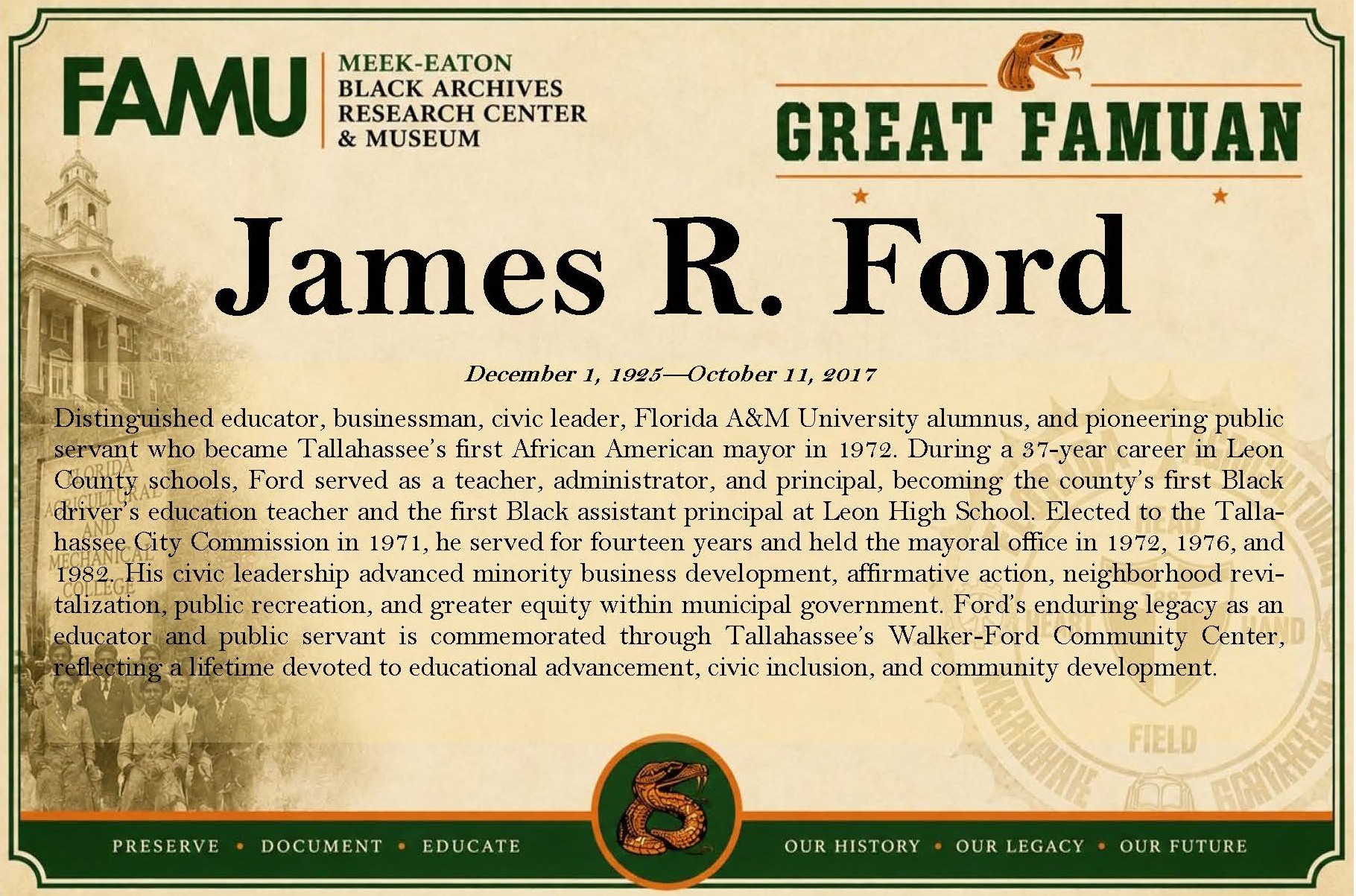
An educator, businessman, military veteran, civic leader, and pioneering public servant whose career profoundly influenced the educational and political development of Tallahassee, Florida. Born and raised in Tallahassee during the era of Jim Crow segregation, Ford witnessed a society in which African Americans faced systematic restrictions in education, employment, housing, public accommodations, recreation, and political participation. His subsequent career would place him among the generation of Black professionals who helped transform many of those institutions during the second half of the twentieth century.
Ford served in the United States Navy during World War II before beginning a lengthy career in public education. For approximately thirty-seven years, he worked within Leon County schools as a teacher, administrator, and principal. His professional career coincided with one of the most transformative periods in American educational history, spanning the final years of legally segregated schooling and the difficult transition toward school desegregation.
Within the Leon County school system, Ford achieved several important professional milestones. He became the county’s first African American driver’s education teacher and later the first Black assistant principal at Leon High School. These appointments represented more than individual professional advancement. They reflected the gradual dismantling of racial barriers that had historically limited the positions available to African American educators within previously segregated educational institutions. Through teaching and administration, Ford contributed to the transformation of public education while establishing himself as a respected professional and community leader.
His career in education provided a strong foundation for his eventual transition into municipal government. As an educator and administrator, Ford developed experience in organizational leadership, communication, mediation, and public responsibility. His work also brought him into sustained contact with families and communities throughout Tallahassee, strengthening his understanding of the social and economic concerns confronting residents of the city.
Ford entered elected government during a pivotal period in Tallahassee’s racial and political history. In 1971, he became the first African American elected to the Tallahassee City Commission in the post-Reconstruction era. His election represented a major milestone in a city where African Americans had historically faced significant barriers to political participation and governmental leadership. It also reflected the broader transformation made possible by decades of civil rights activism, voter mobilization, and demands for equal citizenship.
In 1972, Ford achieved another historic milestone when he became Tallahassee’s first African American mayor. His elevation to the mayoral office was particularly significant in Florida’s capital city, where only a generation earlier segregation had structured many aspects of public life. Ford subsequently served as mayor again in 1976 and 1982 while completing fourteen years of service on the Tallahassee City Commission.
Ford used his position in municipal government to address both the legacy of racial discrimination and the broader needs of a growing city. His public-service agenda included efforts to expand minority participation in municipal employment and economic development, strengthen historically underserved neighborhoods, and improve recreational and community resources. His leadership demonstrated that African American political representation could be accompanied by substantive institutional reform and investment in communities that had historically received unequal access to public resources.
Among the initiatives associated with Ford’s leadership were the establishment of the Minority Business Department, the Frenchtown Area Development Authority, and the Tallahassee Affirmative Action Office. These initiatives sought to address longstanding inequalities in employment, business opportunities, neighborhood development, and participation in municipal affairs. His support for minority-business development was especially important within a historical context in which African American entrepreneurs had often faced barriers to financing, government contracts, commercial opportunities, and institutional networks.
Ford also advocated for the preservation and development of Tallahassee’s neighborhoods and public spaces. His support for the Frenchtown Area Development Authority reflected concern for one of Tallahassee’s most historically significant African American communities. Frenchtown had long served as a center of Black residential, commercial, religious, and cultural life, and Ford recognized the importance of ensuring that municipal development included historically African American neighborhoods.
His civic vision extended to parks, recreation, environmental improvement, and community infrastructure. Ford supported the development of Tom Brown Park and efforts to restore Lake Ella, projects that contributed to Tallahassee’s expanding system of public recreational spaces. He also championed the development of a community center on Tallahassee’s southside, recognizing the importance of providing residents with accessible spaces for recreation, education, youth activities, and community engagement.
That commitment is permanently commemorated through the Walker-Ford Community Center, named in honor of Ford and educator Dr. Courtney Emory Walker. The center stands as one of the most visible reminders of Ford’s dedication to Tallahassee’s southside communities. More than a namesake memorial, the facility represents the type of community investment Ford advocated throughout his public career: public resources designed to strengthen neighborhoods, support young people, and improve the quality of life for residents.
Ford’s historic importance, however, extends beyond his distinction as Tallahassee’s first African American mayor. His life spanned an extraordinary transformation in Southern public life. He entered adulthood when racial segregation remained deeply entrenched and pursued his early professional career within institutions structured by racial inequality. By the height of his public career, he had become a leader within the government of Florida’s capital city. His trajectory therefore reflects the broader expansion of African American political representation that followed the modern Civil Rights Movement.
His accomplishments demonstrate the importance of local leadership in translating the achievements of the Civil Rights Movement into institutional change. Federal legislation and court decisions dismantled many formal structures of segregation, but local officials were responsible for shaping employment policies, municipal services, neighborhood investment, public facilities, contracting opportunities, and the everyday relationship between citizens and government. Ford occupied this critical space between historic civil rights gains and their practical implementation within local government.
James R. Ford remained an important figure in Tallahassee civic life long after his elected service concluded. When he died on October 11, 2017, he left a legacy encompassing nearly four decades in education, fourteen years in municipal government, historic mayoral leadership, and sustained advocacy for community advancement. His achievements helped redefine possibilities for African American leadership within Tallahassee and contributed to the transformation of the city’s educational, governmental, and civic institutions.
Ford should therefore be remembered not solely as a political trailblazer but as an institution builder whose career connected education, public administration, economic opportunity, neighborhood development, and civic responsibility. From the classroom to the mayoral office, his work reflected a sustained commitment to strengthening the community he called home. His legacy remains embedded in Tallahassee’s civic landscape and in the history of African American political leadership in Florida, representing a lifetime devoted to expanding opportunity, improving public institutions, and advancing a more inclusive vision of municipal government.
-
Artifact Dimensions
-
L x W: 24.5 x 20.38in (62.23 x 51.75cm)
-
Medium
-
photograph, dark wood frame with gold metal plaque
-
Rights
-
All rights reserved. The use of any part of these objects and photographs transmitted in any form by any means, electronic, mechanical, photocopying, recording, or otherwise, or stored in a retrieval system without the prior written consent of Meek-Eaton Black Archives is an infringement of the copyright law.
-
Rights Holder
-
Meek - Eaton Southeastern Regional Black Archives Research Center and Museum