-
Title
-
Nanny S. McGuinn
-
Birth Date
-
1870
-
Transition Date
-
1963
-
Category
-
Faculty
-
Affiliation to FAMU
-
Education
-
Life at FAMU
-
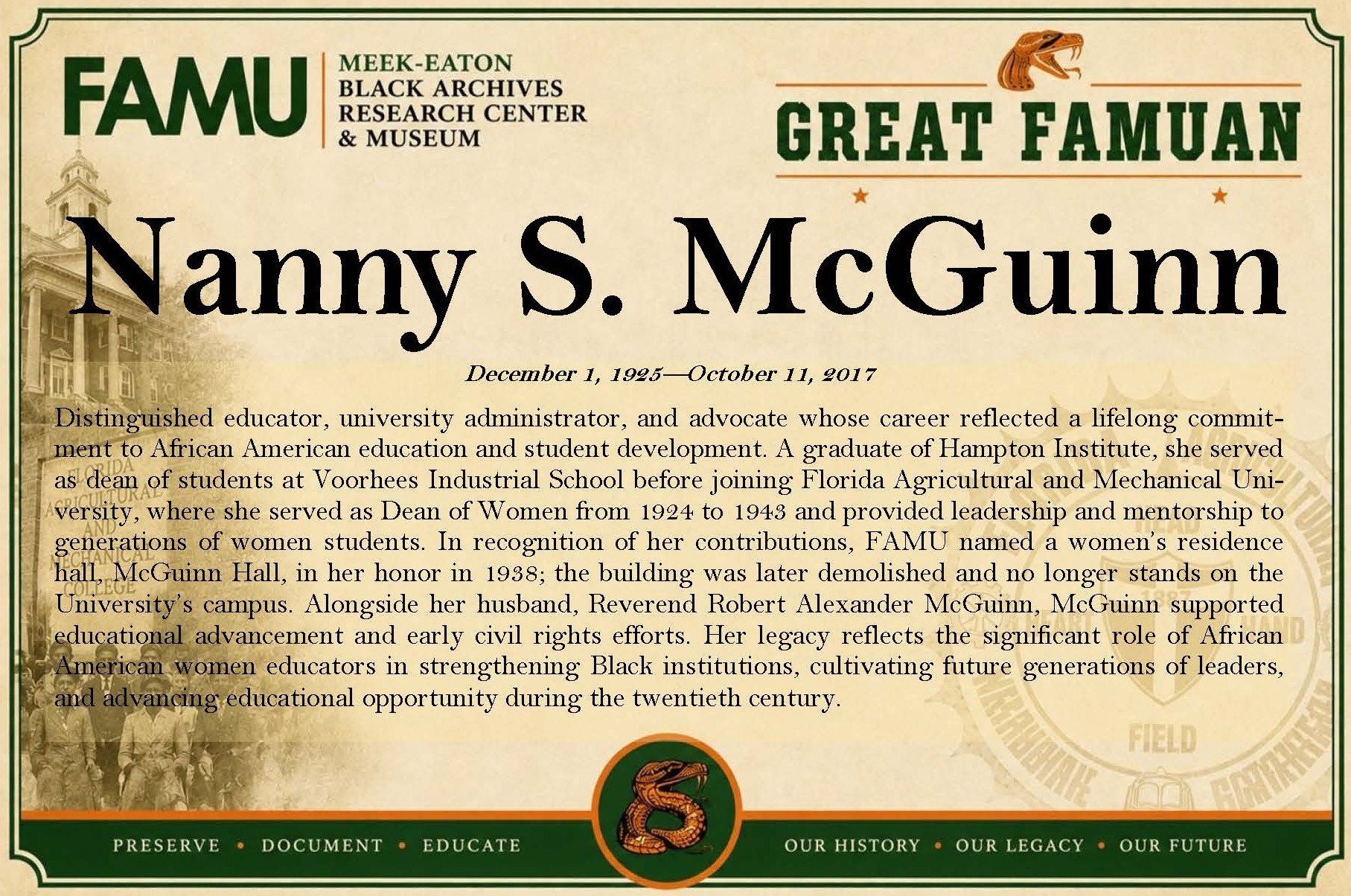
Pioneering educator and university administrator whose nearly two decades of service at Florida Agricultural and Mechanical University contributed significantly to the development of women’s student life and institutional culture during the early twentieth century. Serving as Dean of Women from 1924 to 1943, McGuinn occupied an influential position at a time when historically Black colleges and universities were expanding their academic programs, strengthening administrative structures, and preparing new generations of African American professionals and community leaders.
As Dean of Women, McGuinn was entrusted with responsibilities extending well beyond conventional administrative duties. During the early twentieth century, deans of women commonly exercised broad oversight of female students’ residential, social, and personal development. Their work encompassed student welfare, counseling, conduct, residential life, leadership development, and mentorship. At a historically Black institution operating within the restrictions of Jim Crow segregation, this responsibility carried additional significance. African American women pursuing higher education confronted barriers associated with both race and gender, making the guidance and institutional advocacy of Black women administrators particularly consequential.
McGuinn became an important mentor to generations of FAMU women. Her administrative philosophy reflected a broader educational tradition that understood collegiate education as encompassing intellectual development, personal responsibility, character, leadership, and service. Through her position, she helped cultivate an environment in which women students could prepare for professional careers and assume positions of leadership within their families, institutions, and communities.
Her tenure coincided with an important period in the development of Florida A&M. From the 1920s through the early 1940s, the institution continued to expand its role as one of Florida’s principal centers of higher education for African Americans. McGuinn guided students through periods of profound national change, including the cultural transformations of the 1920s, the economic hardships of the Great Depression, and the opening years of World War II. Throughout these changes, FAMU remained an important source of educational opportunity within a state where segregation severely restricted African Americans’ access to higher education.
McGuinn’s work was particularly important to the development of women’s collegiate life. Historically Black colleges provided educational opportunities that enabled African American women to enter teaching, health care, business, public service, and other professions while developing networks of leadership and civic engagement. Women administrators such as McGuinn helped sustain the environments in which this development occurred. Their influence often extended beyond formal academic instruction through counseling, mentorship, residential supervision, and the cultivation of institutional traditions.
Florida A&M formally recognized McGuinn’s contributions during her lifetime. In 1938, a women’s residence hall was named **McGuinn Hall** in her honor, a significant acknowledgment of her leadership and longstanding service to the University. The naming of a campus building for McGuinn while she was still actively associated with the institution reflected the esteem in which her contributions to generations of women students were held.
McGuinn Hall subsequently became part of the physical history of women’s residential life at Florida A&M. Although the residence hall no longer exists, having been demolished as the University’s campus facilities evolved, its former presence remains an important part of FAMU’s institutional memory. The loss of the physical structure makes the preservation of McGuinn’s biography especially significant. While the building that carried her name has disappeared from the campus landscape, the history represented by that name remains part of the University’s heritage.
McGuinn concluded her service as Dean of Women in 1943 after approximately nineteen years of leadership. Her tenure helped shape the experiences of generations of students and contributed to the development of student life during an important period in FAMU history. Her influence demonstrates the essential role that women administrators played in building historically Black institutions, even when their contributions have not always received the same historical attention as those of presidents, faculty members, and other institutional leaders.
Nanny S. McGuinn’s FAMU legacy is therefore one of mentorship, institutional leadership, and service. As Dean of Women, she helped prepare generations of African American women for lives of professional achievement and community responsibility. The former McGuinn Hall once provided a physical monument to that service; today, its history serves as a reminder of the importance of preserving the stories of the educators and administrators who helped construct the intellectual, social, and cultural foundations of Florida A&M University.
-
Life Bio
-
African American educator, administrator, civic advocate, wife, and mother whose life encompassed nearly a century of extraordinary transformation in Black education and American society. Born during the Reconstruction era, McGuinn belonged to one of the earliest generations of African American women to pursue advanced educational opportunities following emancipation. Her life and career reflected a belief in education, faith, family, and institutional development as essential instruments for African American advancement.
McGuinn pursued her education at Hampton Institute in Virginia, one of the most influential institutions established for African Americans following the Civil War. Founded in 1868, Hampton educated generations of Black teachers and professionals who subsequently carried their training into schools and communities throughout the nation. McGuinn’s attendance placed her within an important tradition of African American women who pursued higher education despite the considerable racial and gender restrictions of the late nineteenth and early twentieth centuries.
Her professional career developed within the expanding network of educational institutions established to serve African American communities. Before relocating to Tallahassee, McGuinn served as dean of students at Voorhees Industrial School in Denmark, South Carolina. Her administrative work there reflected the broad responsibilities assumed by Black educators during an era when African American schools frequently operated with limited resources while carrying substantial expectations for community development.
As an educator and administrator, McGuinn belonged to a generation that understood education as more than individual advancement. African American educational institutions served as centers for professional preparation, leadership development, cultural affirmation, and community building. Educators consequently occupied influential positions within Black civic life, helping prepare students not simply for employment but also for responsibilities as teachers, professionals, parents, community leaders, and citizens.
McGuinn’s personal life was similarly connected to traditions of African American leadership and racial advancement. She was married to Reverend Robert Alexander McGuinn, a minister and activist whose work complemented her commitment to education and community development. Together, the McGuinns participated in early efforts to advance the rights and opportunities of African Americans during a period when segregation, disfranchisement, and racial discrimination remained deeply embedded within American society.
Their partnership reflected the close historical relationship between African American educational and religious institutions. Black churches and schools were among the most important independent institutions available to African Americans during the Jim Crow era. Churches provided spiritual leadership while also functioning as centers of mutual assistance, civic organization, political discussion, and social advocacy. Educational institutions cultivated literacy, professional expertise, leadership, and economic advancement. Through their respective commitments to ministry, education, and activism, Nanny and Robert McGuinn participated in both traditions.
The couple raised four children while maintaining their professional and civic responsibilities. Family, faith, education, and racial progress formed interconnected dimensions of their lives. Their example reflected a broader philosophy of racial advancement prevalent among many African American educators and religious leaders of the period: educational achievement and professional accomplishment carried an accompanying responsibility to strengthen institutions and expand opportunities for subsequent generations.
McGuinn’s civic engagement also places her within the longer chronology of the African American freedom struggle. The nationally recognized Civil Rights Movement of the 1950s and 1960s emerged from generations of earlier organizing by Black educators, ministers, clubwomen, businesspeople, journalists, attorneys, and community advocates. These men and women strengthened institutions, promoted educational opportunity, challenged discriminatory practices, encouraged civic participation, and created networks upon which later civil rights organizations could build.
African American women were especially important within this tradition. Although they frequently encountered discrimination based upon both race and gender, Black women served as educators, administrators, organizers, fundraisers, club leaders, church workers, and community advocates. Their labor was fundamental to the development and preservation of African American institutions. McGuinn’s career should be understood within this larger history of Black women exercising leadership through education and community service.
Her longevity made her a remarkable link between different periods of African American history. Born only a few years after the end of the Civil War, McGuinn witnessed the aftermath of Reconstruction, the emergence and consolidation of Jim Crow segregation, the expansion of African American educational institutions, two world wars, the Great Migration, and the beginnings of the modern Civil Rights Movement. Shortly before her death, she was recognized as one of Hampton Institute’s oldest living graduates.
When McGuinn died in 1963 at approximately ninety-three years of age, the nation was entering one of the most consequential periods of the modern struggle for civil rights. The educational and institutional work to which she and her generation had devoted their lives formed part of the foundation upon which younger activists built campaigns for desegregation, voting rights, and equal citizenship.
Nanny S. McGuinn’s professional and personal legacy therefore extends beyond the individual institutions she served. Her life represents the work of generations of African American women who used education, institutional leadership, faith, family, and civic engagement to expand opportunities in the face of systemic racial inequality. Through her career as an educator and administrator, partnership with Reverend Robert Alexander McGuinn, commitment to family, and participation in the broader struggle for African American advancement, she contributed to a tradition of institution building that strengthened Black communities across generations.
Her life stands as a testament to the transformative role of African American educators in the late nineteenth and twentieth centuries. Nanny S. McGuinn helped create opportunities for those who followed her while embodying a philosophy of leadership grounded in education, service, and collective progress. Her legacy belongs to the broader history of Black women whose often understated but consequential work helped establish the educational and institutional foundations necessary for subsequent generations to pursue greater equality and opportunity.
-
Artifact Dimensions
-
L × W: 62.23 × 72.39 cm
-
Medium
-
Photograph on canvas with dark wood frame
-
Rights
-
All rights reserved. The use of any part of these objects and photographs transmitted in any form by any means, electronic, mechanical, photocopying, recording, or otherwise, or stored in a retrieval system without the prior written consent of Meek-Eaton Black Archives is an infringement of the copyright law.
-
Rights Holder
-
Meek - Eaton Southeastern Regional Black Archives Research Center and Museum