-
Title
-
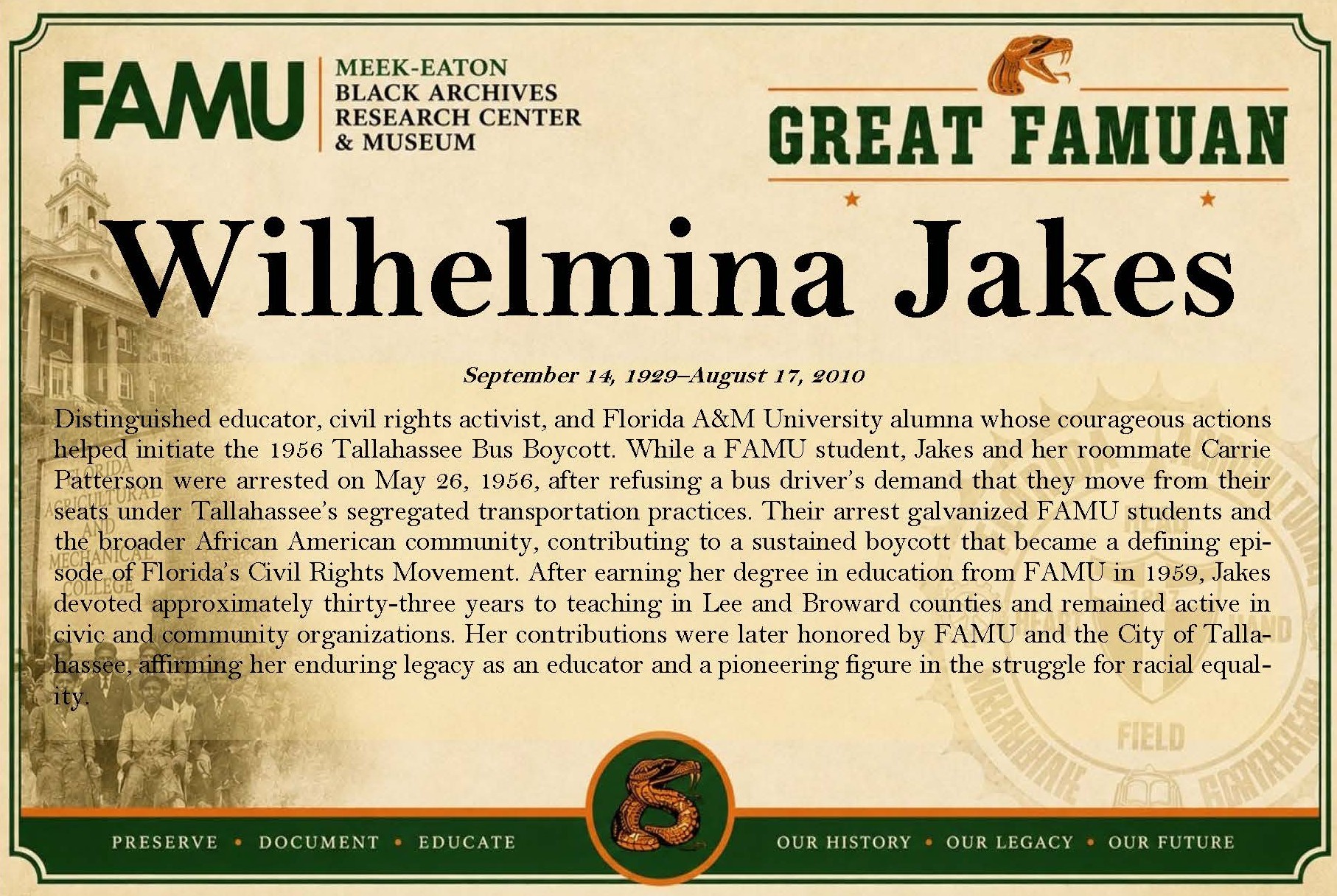
Wilhelmina Jakes
-
Birth Date
-
September 14, 1929
-
Transition Date
-
August 17, 2010
-
Category
-
Civil Rights
-
Affiliation to FAMU
-
Alumna
-
Life at FAMU
-
Alumna, student activist, educator, and pioneering participant in the Tallahassee Civil Rights Movement. Jakes arrived in Tallahassee after completing her secondary education in West Palm Beach, entering Florida Agricultural and Mechanical University during a period when historically Black colleges and universities served as essential centers of African American intellectual development, professional preparation, cultural affirmation, and civic leadership. Her years at FAMU ultimately placed her at the center of one of the most consequential episodes of student activism in the University’s history.
Jakes pursued studies in education at FAMU, preparing for the teaching career that would define much of her professional life. Her collegiate years unfolded during a period of profound change in the United States. Although African Americans continued to confront legally sanctioned segregation throughout the South, the developing Civil Rights Movement was challenging longstanding systems of racial inequality. Within this environment, HBCU students increasingly emerged as important participants in campaigns against segregation and discriminatory public practices.
On May 26, 1956, Jakes and her roommate, fellow FAMU student Carrie Patterson, boarded a crowded Tallahassee city bus. The two women occupied available seats in a three-person seat beside a white female passenger. Under the discriminatory racial practices governing the city's segregated transportation system, their seating brought them into conflict with the bus driver, who instructed them to move. Jakes and Patterson refused to surrender their seats.
The refusal represented more than a dispute over seating. Segregated public transportation was one of the everyday mechanisms through which Jim Crow reinforced racial hierarchy and required African American passengers to accept unequal treatment. By declining to move, Jakes and Patterson asserted their dignity and challenged a system that subordinated the rights of Black passengers to racial convention.
The bus driver summoned law enforcement, and Jakes and Patterson were arrested and charged with placing themselves in a position to incite a riot. University personnel subsequently became involved in assisting with their release. The arrest of two FAMU students quickly transformed what had begun as an encounter aboard a city bus into an issue that mobilized the University community.
FAMU students responded with organized action. Under the leadership of Student Government Association President Brodes Hartley and other student leaders, students assembled to consider a collective response to the treatment of Jakes and Patterson and to the larger problem of segregated transportation. Students supported withdrawing their patronage from Tallahassee's municipal buses, providing the initial momentum for what became the Tallahassee Bus Boycott.
The developing protest illustrates the significant role Florida A&M students played in the city's Civil Rights Movement. Their response demonstrated that students were not merely observers of the national struggle over segregation but active participants capable of initiating and sustaining demands for social change. The University community provided a concentration of educated young African Americans who increasingly questioned the legitimacy of racial practices that restricted their citizenship beyond the campus.
As the protest expanded beyond FAMU, Tallahassee's African American religious and civic institutions became essential to sustaining the movement. Reverend C.K. Steele and other community leaders helped organize the Inter-Civic Council, which coordinated transportation, communication, strategy, and community participation. Students, ministers, educators, professionals, and residents consequently formed a broader coalition against segregated transportation.
Jakes's role in this history demonstrates the critical relationship between student activism and community organization. Her refusal with Patterson provided an immediate catalyst for protest, while the collective response of FAMU students helped transform their arrests into organized resistance. The wider Black community then supplied the institutional infrastructure necessary to sustain the campaign. This progression from individual action to student mobilization and community organization became characteristic of numerous campaigns during the Civil Rights era.
Her experience also places an African American woman at the center of FAMU's civil rights history. Black women were indispensable to the freedom struggle as organizers, educators, strategists, fundraisers, activists, and community leaders, yet their contributions were frequently overshadowed within narratives emphasizing nationally prominent male figures. Jakes and Patterson demonstrate that young Black women were among those whose willingness to confront discrimination directly helped initiate larger movements.
Despite the disruption and personal risks associated with civil rights activism, Jakes continued her education. She graduated from Florida A&M University in 1959 with a degree in education. Her completion of the degree represented an important personal achievement and prepared her for a professional career devoted to teaching.
Jakes maintained a relationship with the FAMU community after graduation through the Florida A&M University Alumni Association. As the historical significance of the 1956 movement received greater recognition, the University formally honored the role that Jakes and Patterson played in its civil rights heritage. In 2006, fifty years after their arrest and the resulting boycott, FAMU recognized the women with distinguished alumni honors and its Freedom Award.
The recognition represented an important act of institutional remembrance. Jakes had entered FAMU as a student seeking an education, but her experiences there became inseparable from the University's larger historical identity. Her actions and those of Patterson, Hartley, and other student activists helped establish FAMU as an important site within the history of Florida's Civil Rights Movement.
Wilhelmina Jakes's FAMU legacy therefore extends beyond her status as a graduate. Her collegiate experience demonstrates the historic relationship among education, student leadership, and civic responsibility at historically Black institutions. Through an act of resistance to discriminatory treatment, she helped inspire a collective response that connected the University with Tallahassee's wider African American community and contributed to the struggle against segregation.
Her life at FAMU remains a powerful example of how students can become consequential historical actors. Jakes's pursuit of education, courage in challenging racial discrimination, and subsequent commitment to her alma mater place her among the important figures in Florida A&M University's history. Her legacy preserves the memory of a generation of Rattlers whose education prepared them not only for professional achievement but also for engagement with the defining questions of citizenship, equality, and justice confronting their time.
-
Life Bio
-
Distinguished educator, civil rights activist, civic participant, wife, and mother whose life reflected a sustained commitment to education, community service, and racial advancement. Born in Hardeeville, South Carolina, to Joseph and Lillie Bell Jakes, she came of age during an era when racial segregation profoundly shaped the educational, economic, and social experiences of African Americans throughout the South.
Following the death of her father, Jakes relocated with her mother and siblings to West Palm Beach, Florida. There, she attended Industrial High School, graduating in 1948. Her family's relocation and her subsequent educational advancement occurred within the broader context of African American communities building institutions and pursuing educational opportunities despite the limitations imposed by Jim Crow segregation.
Education became the central focus of Jakes's professional life. After completing her collegiate preparation, she embarked upon a teaching career that extended approximately thirty-three years. She served students in Lee and Broward counties, devoting more than three decades to public education. Her lengthy career reflected a commitment to the intellectual and personal development of younger generations and placed her within a distinguished tradition of African American educators whose professional work contributed significantly to community advancement.
Jakes's decision to become an educator carried particular historical significance. For generations, teaching represented one of the principal professions through which African American women exercised intellectual and civic leadership. Black educators served not only as classroom instructors but also as mentors, community leaders, institution builders, and advocates for educational opportunity. Their work helped prepare generations of students to participate in a society undergoing substantial racial, social, and political transformation.
Jakes entered the profession during the era in which American public education was confronting the consequences of segregation and the difficult process of desegregation. Her thirty-three-year career therefore spanned a transformative period in educational history. As schools and communities responded to changing legal and social expectations, educators such as Jakes occupied an important position in helping students navigate those transitions.
Her professional service in education was complemented by sustained participation in civic and community organizations. Jakes was affiliated with Alpha Kappa Alpha Sorority, Incorporated, an organization with a longstanding tradition of scholarship, service, and advocacy among African American women. Through sorority life and other forms of community engagement, she remained connected to networks of women committed to education, social advancement, and public service.
Jakes was also a life member of the National Association for the Advancement of Colored People. Her affiliation with the NAACP reflected a continuing commitment to the broader struggle for African American civil and human rights. The organization had played a foundational role in challenging racial discrimination through litigation, advocacy, voter engagement, and community organization throughout much of Jakes's lifetime.
Her civic involvement additionally included participation in the Women's Federated Club. African American women's clubs historically served important functions within Black communities, supporting educational initiatives, charitable programs, civic improvement, cultural development, and campaigns for racial and social progress. Jakes's participation situated her within this longer tradition of Black women's organized community leadership.
The combination of teaching and civic engagement reveals the broader character of Jakes's service. Her contributions were not confined to a single historic episode. Rather, they encompassed decades of work in classrooms, professional environments, civic organizations, alumni networks, and community institutions. Her life illustrates how civil rights leadership could continue through the everyday work of educating children, strengthening organizations, and supporting community development.
Public recognition of Jakes's historical contributions increased during the later years of her life. Her role in challenging racial segregation became part of a broader effort to document and commemorate the local activists whose actions contributed to the transformation of the American South. This recognition helped ensure that the contributions of women and grassroots activists became more visible within the historical record.
In 2009, Tallahassee commemorated the contributions of Jakes and Carrie Patterson by renaming three blocks of Jennings Street between Adams and Bronough streets in their honor. The designation created a permanent public memorial to two African American women whose courage had contributed to the struggle against segregated public transportation more than half a century earlier.
The commemoration was particularly meaningful because streets and transportation systems had once been among the everyday spaces in which racial inequality was enforced. Associating the names of Jakes and Patterson with the city's landscape transformed a public space into an instrument of historical memory, preserving the contributions of women who challenged discriminatory practices within that same city.
Jakes's personal life was also an important dimension of her story. She was married to the late Napoleon Street, and together they had one daughter, Dr. Priscilla Lewis. Her roles as wife and mother accompanied a demanding professional career and decades of civic involvement, reflecting the multiple responsibilities undertaken by many African American women leaders of her generation.
In the final year of her life, Jakes returned to West Palm Beach, the community where she had spent her formative years following her family's relocation from South Carolina. She died there on August 17, 2010. Her death concluded a life that had spanned extraordinary changes in American society—from the deeply entrenched segregation of her youth through the transformations produced by the Civil Rights Movement and subsequent generations of African American professional and civic advancement.
Wilhelmina Jakes's professional legacy is most enduringly reflected in the thousands of students whose lives intersected with her thirty-three years as an educator. While history remembers her courage as a civil rights activist, teaching constituted the sustained work of her adult professional life. Her commitment to education demonstrates that social advancement occurs not only through public protest but also through the patient work of preparing subsequent generations.
Her broader life represents the intersection of education, civil rights, women's leadership, family, and community service. Through her career as an educator, membership in civic organizations, commitment to racial advancement, and dedication to family, Jakes exemplified a tradition of African American women's leadership that combined professional achievement with responsibility to community.
Wilhelmina Jakes should therefore be remembered both for the courage that made her an important figure in civil rights history and for the decades of service that followed. Her life demonstrates that a historic act of resistance can form one chapter within a much larger story of education, mentorship, civic participation, and service. Her enduring legacy resides in both the barriers she helped challenge and the generations she subsequently helped educate.
-
Artifact Dimensions
-
L x W: 22 x 18in (55.88 x 45.72cm)
-
Medium
-
Photograph on canvas, silver painted frame
-
Rights
-
All rights reserved. The use of any part of these objects and photographs transmitted in any form by any means, electronic, mechanical, photocopying, recording, or otherwise, or stored in a retrieval system without the prior written consent of Meek-Eaton Black Archives is an infringement of the copyright law.
-
Rights Holder
-
Meek - Eaton Southeastern Regional Black Archives Research Center and Museum