-
Title
-
James Abner
-
Birth Date
-
January 20, 1908
-
Transition Date
-
December 16, 1959
-
Category
-
Education
-
Affiliation to FAMU
-
Supporter
-
Life at FAMU
-
Tallahassee educator, entrepreneur, and civic leader whose life and work were closely connected to the African American community surrounding Florida Agricultural and Mechanical University. Although his principal educational career was associated with Lincoln High School, Abner contributed to the broader social and economic environment in which FAMU students, faculty, families, alumni, and visitors lived and interacted during the era of racial segregation.
Abner's relationship to the FAMU community is particularly significant through his establishment of the Abner–Virginia Motel, located near Bragg Drive and Railroad Avenue in the University's surrounding neighborhood. During the Jim Crow era, African American travelers were routinely denied accommodations at white-owned hotels and motels. This discrimination created an urgent need for Black-owned establishments capable of providing safe, dignified, and dependable lodging.
The location of the Abner–Virginia Motel near Florida A&M placed the business within an important center of African American educational and cultural activity. FAMU attracted students and their families, educators, alumni, professionals, performers, athletic visitors, and other guests to Tallahassee. Yet the segregated hospitality industry severely limited where African American visitors could stay. Black-owned establishments such as Abner's therefore performed a function that extended beyond conventional entrepreneurship: they helped sustain the infrastructure necessary for Black mobility, professional exchange, education, and community life.
Abner's work should consequently be understood within the larger African American institutional landscape surrounding Florida A&M. The University did not exist in isolation from the neighborhoods around it. Black-owned businesses, churches, schools, residences, professional offices, fraternal organizations, and civic institutions collectively supported the people who studied and worked at FAMU. Entrepreneurs such as Abner contributed to an ecosystem that allowed the University community to function within a city still governed by segregation.
His professional work as an educator further connected him to Tallahassee's broader tradition of African American educational advancement. Abner served at the original Lincoln High School in Frenchtown, one of the city's principal educational institutions for Black students during segregation. Lincoln High and Florida A&M occupied different positions within the educational system, but both were important institutions within Tallahassee's Black community. Together with other African American schools and organizations, they formed an educational network through which Black students could pursue intellectual development and prepare for professional and civic leadership.
Abner's dual roles as educator and entrepreneur are especially meaningful within this historical context. Education and economic self-determination were central strategies through which African Americans sought advancement during Jim Crow. Teachers and administrators cultivated future generations, while Black business owners created employment, provided necessary services, circulated resources within the community, and established spaces in which African Americans could receive treatment frequently denied elsewhere.
The FAMU area itself developed as an important center of African American residential, commercial, intellectual, and social life. Businesses surrounding the campus benefited from and supported the University's presence, while FAMU contributed to the growth of a professional Black community in Tallahassee. Abner's activities exemplified this relationship between a historically Black university and the community infrastructure surrounding it.
His involvement in fraternal life also intersected with the culture of education and service characteristic of the FAMU community. As a founding charter member of the Beta Lambda Sigma Chapter of Phi Beta Sigma Fraternity, Incorporated, in Leon County in 1949, Abner participated in a network of African American professional men organized around scholarship, brotherhood, and service. Black Greek-letter organizations were important components of twentieth-century African American professional and civic life, including within communities surrounding historically Black colleges and universities.
Abner's life therefore provides an important perspective on the broader meaning of the FAMU community. The history of Florida A&M encompasses not only those who studied, taught, or administered within the University but also the entrepreneurs, educators, religious leaders, professionals, and residents who built institutions around the campus and helped sustain generations of Rattlers and their families.
Through the Abner–Virginia Motel and his broader educational and civic leadership, James Abner contributed to the community infrastructure surrounding Florida A&M during one of the most restrictive periods of racial segregation. His story illustrates the reciprocal relationship between FAMU and Tallahassee's African American community—a relationship in which the University helped cultivate Black professional and intellectual life while surrounding Black institutions and businesses provided essential support to the people who made up the University community.
Abner's connection to FAMU should therefore be remembered as part of the larger history of African American institution-building in Tallahassee. His contributions demonstrate that the strength of a historically Black university depended not solely upon what occurred within the boundaries of its campus, but also upon the network of Black institutions, businesses, and community leaders that created spaces of dignity, opportunity, hospitality, and service around it.
-
Life Bio
-
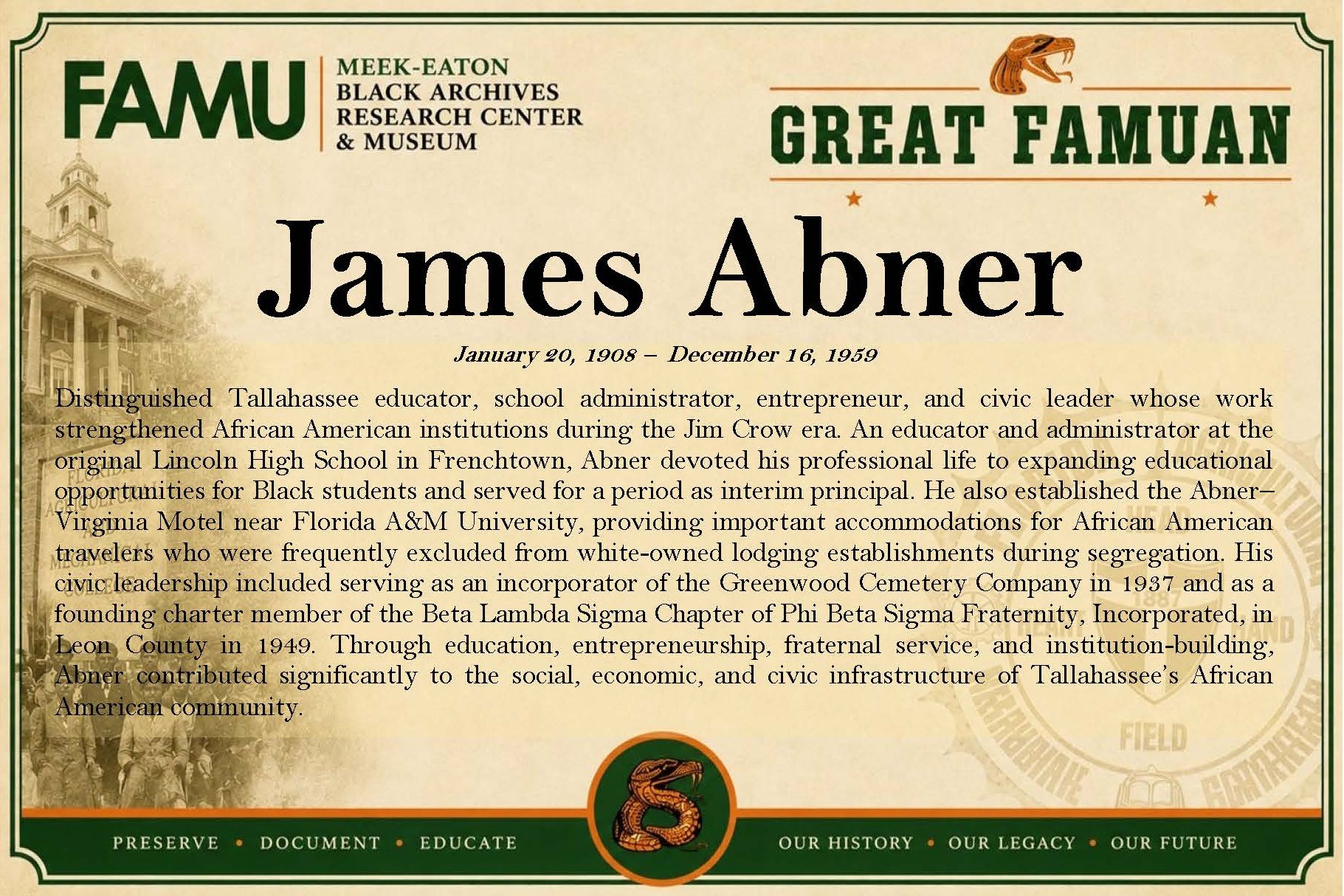
Distinguished Tallahassee educator, school administrator, entrepreneur, fraternal leader, and civic advocate whose life reflected a sustained commitment to strengthening African American institutions during the Jim Crow era. Through education, business ownership, and civic organization, Abner helped create and sustain institutions that served Black residents at a time when segregation restricted African Americans' access to many public and private services.
Education was central to Abner's professional life. He served as an educator and administrator at the original Lincoln High School in Tallahassee's historic Frenchtown community and served for a period as interim principal during the late 1950s. Lincoln High was among the city's most important institutions for African American secondary education during segregation and occupied a significant place in the intellectual, social, and cultural life of Tallahassee's Black community.
Abner's role as an educator placed him within a distinguished tradition of African American teachers and administrators who assumed responsibilities extending well beyond classroom instruction. Under segregated educational systems, Black schools frequently operated with fewer financial and material resources than schools serving white students. Nevertheless, African American educators built rigorous educational communities in which students were encouraged to pursue academic achievement, professional advancement, leadership, and service.
Principals and teachers were also influential civic figures within African American communities. Their educational training and public responsibilities often positioned them as organizers, mentors, advisers, and advocates. Abner's movement between education, entrepreneurship, fraternal service, and civic affairs exemplified this broader model of Black professional leadership.
His entrepreneurial activities were equally significant. Abner established the Abner–Virginia Motel, providing accommodations to African American travelers during an era when racial discrimination routinely excluded them from white-owned hotels and motels. Black travelers could not assume that lodging, restaurants, gasoline stations, or other services would be available to them, making Black-owned and Black-friendly businesses essential to safe travel.
The Abner–Virginia Motel was therefore more than a commercial enterprise. It formed part of a larger network of African American businesses that created spaces of hospitality and dignity within a segregated society. Such establishments enabled Black families, educators, professionals, entertainers, businesspeople, and other travelers to move through communities where their access to accommodations was otherwise severely restricted.
Abner also participated in institution-building through his involvement with Greenwood Cemetery. In 1937, he was among the incorporators of the Greenwood Cemetery Company, established to provide burial grounds for Tallahassee's African American community. This work addressed another consequence of segregation, which extended into cemeteries and burial practices.
The establishment of African American cemeteries represented an important expression of community autonomy and dignity. These spaces provided families with places to bury and memorialize loved ones while also becoming repositories of community history. Cemeteries preserve the names and relationships of generations and constitute important historical landscapes through which the development of African American communities can be traced.
Fraternal service represented another significant component of Abner's civic life. In 1949, he became a founding charter member of the Beta Lambda Sigma Chapter of Phi Beta Sigma Fraternity, Incorporated, in Leon County. His participation reflected the important role of Black Greek-letter organizations in African American professional and civic life during the twentieth century.
Graduate fraternity chapters brought together educators, entrepreneurs, clergy, professionals, and community leaders around shared commitments to scholarship, service, mentorship, and social advancement. In communities constrained by segregation, these organizations provided important networks through which African American professionals could coordinate civic initiatives, support education, cultivate leadership, and strengthen community institutions.
Abner's activities across education, business, cemetery development, and fraternal service reveal a consistent philosophy of institution-building. Rather than operating in isolated professional spheres, he participated in interconnected structures that addressed essential community needs. Schools educated young people; businesses provided goods, services, employment, and economic independence; cemeteries protected dignity and memory; and fraternal organizations created networks of leadership and service.
His career therefore provides insight into the strategies African Americans employed to sustain their communities during segregation. Jim Crow restricted Black participation in many institutions, but African Americans responded by developing their own educational, economic, religious, social, and civic structures. These institutions became foundations of community resilience and eventually provided networks through which later campaigns for civil rights could organize.
Abner's life was closely associated with Tallahassee's historic African American communities, particularly Frenchtown and the city's Southside. These neighborhoods contained schools, churches, businesses, residences, social organizations, and professional offices that collectively constituted a thriving Black civic landscape. His work helped strengthen this environment during a period when African Americans were systematically denied equal access to many of the city's institutions.
James Abner died on December 16, 1959, at the age of fifty-one. He was laid to rest at Greenwood Cemetery, the institution whose development he had helped support more than two decades earlier. His burial there creates a particularly meaningful connection between his civic service and his personal legacy.
Abner's professional legacy cannot be reduced to a single position or accomplishment. His significance rests instead in the cumulative impact of a career devoted to building and sustaining institutions. As an educator, he helped prepare African American youth for their futures. As an entrepreneur, he created a place of hospitality for Black travelers. As a civic leader, he contributed to the establishment of a dignified burial ground for his community. As a fraternity member, he helped develop an organization dedicated to scholarship, brotherhood, and service.
James Abner's life thus represents an important chapter in the history of African American Tallahassee. His leadership demonstrates how education, entrepreneurship, civic responsibility, and collective organization functioned together as strategies for community advancement under segregation. Through the institutions he served and helped establish, Abner contributed to the educational, economic, and civic foundations upon which subsequent generations of Tallahassee's African American community continued to build.
-
Artifact Dimensions
-
L x W: 22.38 x 18.75in (56.83 x 47.63cm)
-
Medium
-
Hand drawn chalk , Dark wood frame
-
Rights
-
All rights reserved. The use of any part of these objects and photographs transmitted in any form by any means, electronic, mechanical, photocopying, recording, or otherwise, or stored in a retrieval system without the prior written consent of Meek-Eaton Black Archives is an infringement of the copyright law.
-
Rights Holder
-
Meek - Eaton Southeastern Regional Black Archives Research Center and Museum