-
Title
-
Edward Jones
-
Category
-
Faculty
-
Life at FAMU
-
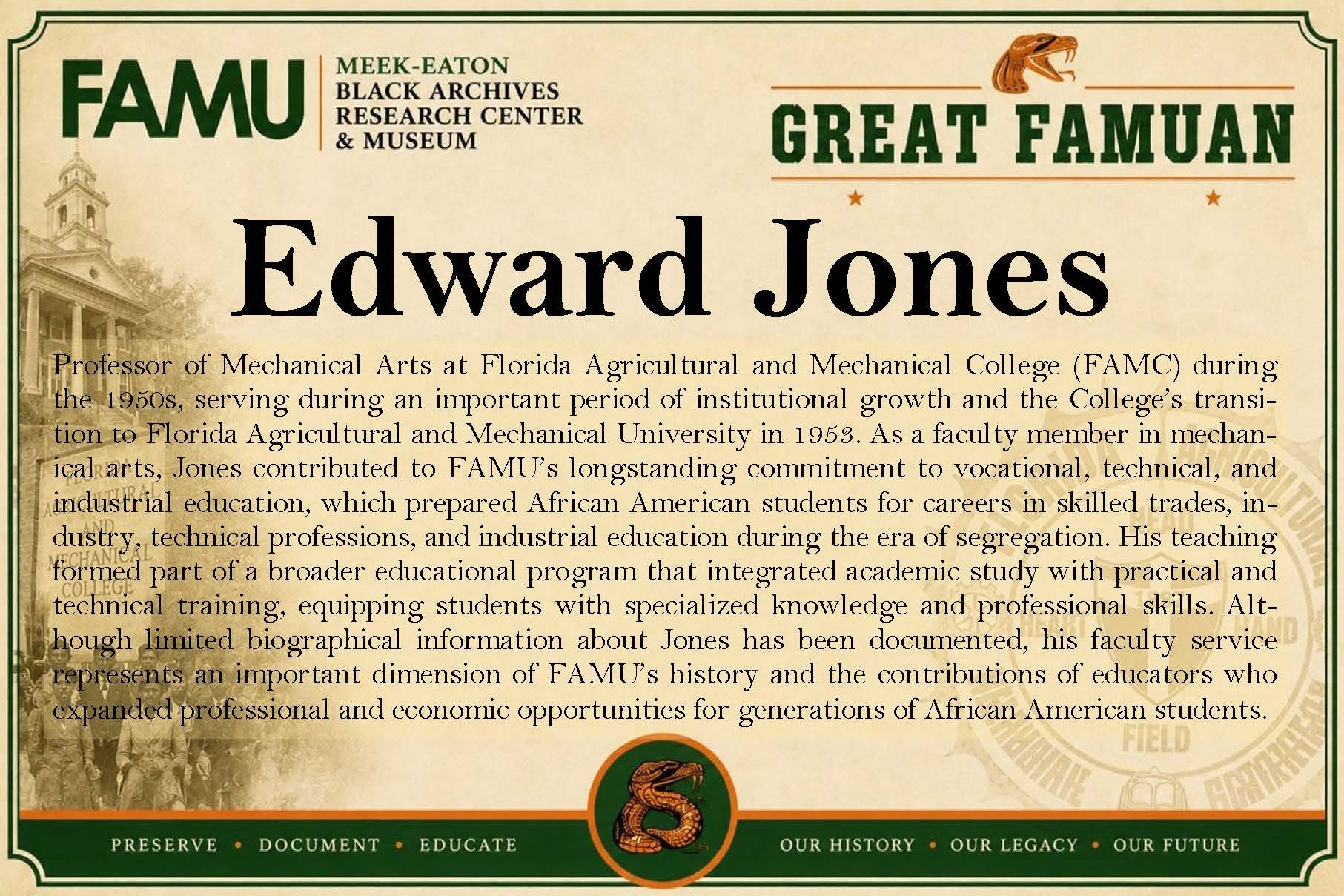
Professor of Mechanical Arts at Florida Agricultural and Mechanical College (FAMC) during the 1950s, serving during an important period of growth and transformation in the institution's history. His faculty appointment placed him within Florida A&M's longstanding tradition of agricultural, mechanical, vocational, and industrial education and among the educators responsible for preparing African American students for skilled, technical, professional, and teaching careers.
Jones's service coincided with a particularly significant institutional transition. During the early 1950s, the institution operated as Florida Agricultural and Mechanical College for Negroes, commonly known as FAMC. In 1953, the College achieved university status and became Florida Agricultural and Mechanical University. As a faculty member during this period, Jones participated in an educational community that was expanding its academic and professional programs while strengthening its role as one of the nation's historically Black institutions of higher education.
Mechanical arts occupied an important place within the institution's educational mission. Instruction in this field emphasized the relationship between technical knowledge and practical application, preparing students to understand the tools, materials, processes, and methods associated with industry and the skilled trades. Such preparation cultivated not only technical proficiency but also problem-solving, precision, craftsmanship, and professional discipline.
Jones's teaching was situated within a broader vocational and technical curriculum that included areas such as engineering, building construction, vocational industrial education, industrial arts education, and trade and technical training. These programs were designed to prepare technicians, skilled workers, tradesmen, industrial educators, and other professionals capable of contributing to an increasingly technological and industrial economy.
Teacher preparation was also an important component of this work. Students pursuing industrial and vocational education combined technical coursework with professional education, enabling graduates to carry their knowledge into classrooms and training programs. In this way, the influence of faculty members such as Jones could extend beyond the students they taught directly, as graduates subsequently educated and trained additional generations.
Jones's work at FAMC must also be understood within the realities of segregated higher education. During the 1950s, African American students faced substantial racial barriers to educational programs, professional training, apprenticeships, and employment. Historically Black colleges and universities consequently served an essential role in developing educational pathways through which Black students could acquire specialized knowledge, professional credentials, and technical expertise.
As a professor of Mechanical Arts, Jones contributed to this larger mission of educational and economic advancement. His classroom and technical instruction helped connect academic study with practical preparation for professional life, reinforcing Florida A&M's commitment to producing graduates equipped to enter industry, education, and the skilled professions.
Although additional research is necessary to document the full scope of Edward Jones's tenure, courses, and contributions, his known faculty service preserves an important chapter in FAMU's academic history. His story represents the many professors whose sustained instructional work helped build the University's reputation and expand opportunities for African American students.
Edward Jones's legacy at Florida A&M therefore rests within a broader tradition of teaching, technical education, and professional preparation. His service during the institution's transition from FAMC to FAMU places him among the educators who helped sustain its educational mission during a transformative period in its history. Through his work in Mechanical Arts, Jones contributed to an institutional tradition dedicated to combining knowledge with practical skill and using education as a pathway toward professional opportunity and economic advancement.
-
Life Bio
-
African American educator and professor whose professional career included service in Mechanical Arts at Florida Agricultural and Mechanical College during the 1950s. Although significant details concerning his birth, family, early education, and life outside the institution have not yet been documented, his known professional appointment identifies him as a participant in the development of vocational, technical, and industrial education during the mid-twentieth century.
Jones belonged to a generation of educators working during a period of rapid industrial and technological change in the United States. The decades following World War II witnessed expanding construction, manufacturing, infrastructure, and technological development, creating increased demand for individuals trained in technical occupations and skilled trades. Educators in mechanical and industrial fields were responsible for preparing students to participate in this changing professional environment.
Mechanical arts education combined intellectual understanding with applied knowledge. Faculty members working in the discipline introduced students to the principles, tools, materials, processes, and techniques associated with mechanical and industrial work. The field demanded precision, planning, problem-solving, technical competency, and an understanding of the relationship between design and production.
For African American educators and students, this work occurred within the additional constraints imposed by racial segregation. Black Americans frequently encountered discriminatory barriers to technical training, apprenticeships, professional organizations, and employment. African American educators working within historically Black institutions consequently performed an especially important role in creating pathways toward professional preparation and economic mobility.
Jones's professional identity as an educator placed him within this larger tradition. Rather than simply practicing a technical occupation, he participated in the transmission of specialized knowledge to others. Through teaching, demonstration, laboratory or shop instruction, and mentorship, educators in mechanical arts helped students transform theoretical principles into practical abilities that could be applied in industry, education, construction, and related professions.
His work also contributed to the preparation of future educators. Industrial arts and vocational education programs trained teachers who would subsequently introduce technical subjects to students in secondary schools and other educational settings. This multiplier effect gave technical faculty an influence that could extend well beyond a single classroom or institution.
The limited surviving information concerning Jones also illustrates an important challenge in documenting African American educational history. Many educators who made sustained contributions to historically Black institutions remain only partially represented in archival and published records. Faculty directories, catalogs, yearbooks, personnel files, photographs, departmental records, and institutional correspondence may preserve evidence of individuals whose fuller personal histories have yet to be reconstructed.
For this reason, Jones's biography remains a developing historical record. Additional archival research may eventually establish his educational background, family history, professional affiliations, specific teaching responsibilities, length of faculty service, and career before or after his documented work in Mechanical Arts.
What can presently be established, however, is his participation in a consequential area of twentieth-century African American education. As a professor of Mechanical Arts, Edward Jones contributed to the preparation of students for skilled employment, technical professions, industrial education, and teaching at a time when access to such opportunities remained profoundly shaped by racial inequality.
His professional legacy therefore resides in the educational work he performed and in the broader tradition he represented. Edward Jones stands among the many African American educators whose expertise and instruction helped develop technically skilled and professionally prepared generations during the era of segregation. While further research is necessary to recover the fuller dimensions of his personal story, his documented career preserves his place within the history of technical education and the advancement of educational opportunity for African American students.
-
Artifact Dimensions
-
L x W: 24.75 x 16.75in (62.87 x 42.55cm)
-
Medium
-
Enlarged printed photo, light wood frame
-
Rights
-
All rights reserved. The use of any part of these objects and photographs transmitted in any form by any means, electronic, mechanical, photocopying, recording, or otherwise, or stored in a retrieval system without the prior written consent of Meek-Eaton Black Archives is an infringement of the copyright law.
-
Rights Holder
-
Meek - Eaton Southeastern Regional Black Archives Research Center and Museum