-
Title
-
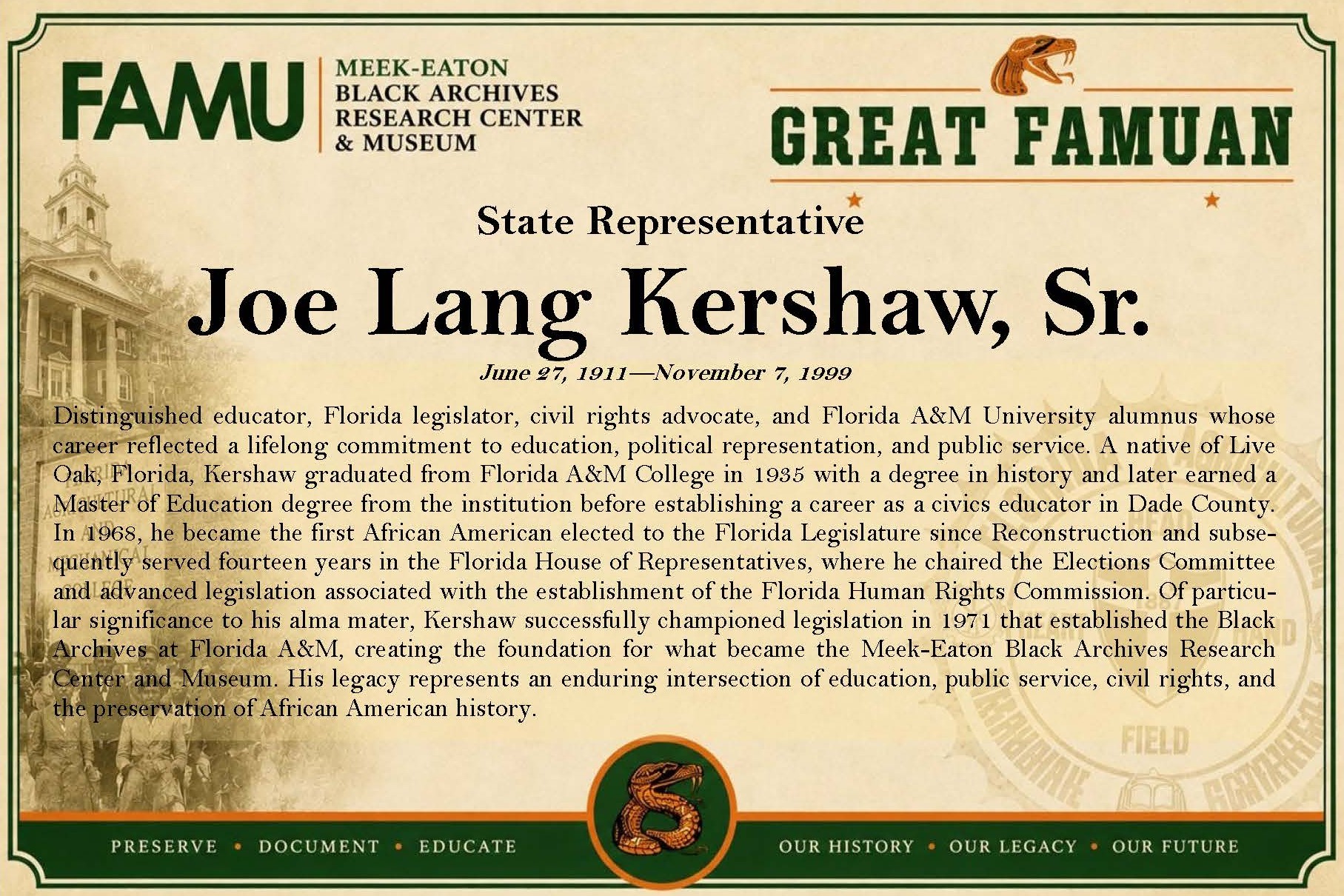
Joe Lang Kershaw, Sr.
-
Alternative Title
-
Representative Joe Lang Kershaw
-
Birth Date
-
June 27, 1911
-
Transition Date
-
November 7, 1999
-
Category
-
Civil Service
-
Affiliation to FAMU
-
Alumni
-
Life at FAMU
-
Distinguished alumnus of Florida Agricultural and Mechanical College whose relationship with the institution evolved from student to advocate, benefactor, and instrumental figure in the establishment of the Black Archives. His life illustrates the enduring influence of Florida A&M upon generations of African American educators and public servants and, equally, the transformative contributions alumni have made to the University.
A native of Live Oak, Florida, Kershaw attended Florida Agricultural and Mechanical College during the 1930s, pursuing studies in history and social studies. He graduated in 1935 and later returned to his alma mater for graduate study, earning a master's degree in education. His academic preparation provided a foundation for his subsequent career as an educator and helped cultivate an enduring interest in history, citizenship, government, and public affairs.
Kershaw's years at FAMC occurred during an era when historically Black colleges and universities served an indispensable role in African American advancement. Segregation severely restricted Black students' access to many public institutions of higher education, making institutions such as Florida A&M essential centers of intellectual development, professional preparation, leadership formation, and community advancement.
One of the most compelling episodes of Kershaw's student years foreshadowed his later career. While attending Florida A&M, he worked as a janitor at the Florida Capitol. According to accounts of his life, Kershaw occasionally stood at the Speaker's podium after completing his duties and imagined himself addressing the Florida House of Representatives. At the time, African Americans had been effectively excluded from legislative representation in Florida for decades. His eventual return to the Capitol as an elected representative gave this youthful aspiration extraordinary historical significance.
Kershaw's FAMU education prepared him for a career in teaching, particularly in civics and social studies. The relationship between his academic preparation and subsequent public service was especially meaningful. He first taught students about government and citizenship before eventually becoming directly involved in the legislative process himself.
His most enduring contribution to Florida A&M came after he entered the Florida Legislature. In 1971, Kershaw helped advance legislation that provided for the establishment of a repository at Florida A&M devoted to the collection and preservation of African American historical materials. This legislative action provided the foundation for the Black Archives at FAMU.
The establishment of the Black Archives represented an important intervention in the preservation of African American history. For generations, records documenting Black communities had frequently been overlooked by traditional collecting institutions, dispersed among families and organizations, or lost because adequate repositories did not exist to preserve them. Creating an institution specifically charged with collecting and interpreting this history affirmed that African American experiences were essential to understanding Florida, the United States, and the broader African Diaspora.
Kershaw's role was especially appropriate given his own academic background in history. The former history student used his legislative authority to help create an institution dedicated to ensuring that the histories of African Americans would be collected, preserved, studied, and transmitted to future generations.
The Black Archives subsequently developed under the leadership of Professor James N. Eaton, who became its founding director and built an extensive program of collecting, research, exhibition, and public interpretation. The institution eventually became the Meek-Eaton Black Archives Research Center and Museum, preserving the names and contributions of both Dr. Carnegie Meek and Professor Eaton while continuing the mission made possible through the legislative initiative championed by Kershaw.
The historical relationship between Kershaw and the Black Archives possesses particular significance because the institution he helped establish eventually became a repository for his own documentary legacy. The preservation of records relating to his life and career allows researchers and future generations to study not simply his legislative accomplishments but also the broader history of African American political participation and public service in Florida.
FAMU also commemorated Kershaw's contributions through the Representative Joe Lang Kershaw FAMUANA Room in the historic Carnegie Library, the original home of the Black Archives. This recognition connected his identity as an alumnus with his role in ensuring the preservation of the University's and African American communities' historical records.
Kershaw's relationship with Florida A&M therefore extended far beyond the conferral of his degrees. FAMU provided an intellectual foundation for his professional career, while Kershaw subsequently used his position in public service to strengthen his alma mater and expand its capacity to preserve African American history.
His story also embodies an important dimension of the University's legacy. Florida A&M has historically prepared graduates not simply for professional careers but for leadership and service. Kershaw transformed the education he received at FAMC into decades of teaching, civic participation, legislative service, and historical preservation.
From a student studying history and imagining himself speaking from the Florida House podium to a legislator responsible for helping establish one of his alma mater's most important cultural institutions, Joe Lang Kershaw Sr. maintained a remarkable relationship with Florida A&M. His legacy remains permanently embedded within the history of the University and the Meek-Eaton Black Archives Research Center and Museum, an institution whose continuing work in preservation, scholarship, and public history stands as one of the most enduring expressions of his commitment to FAMU.
-
Life Bio
-
Educator, legislator, civic leader, and advocate whose career represented an important chapter in the history of African American political participation in twentieth-century Florida. Born in Live Oak, Florida, Kershaw built a professional life that moved from the classroom to the state legislature while remaining grounded in education, citizenship, civil rights, and service to communities historically excluded from political power.
Education formed the foundation of Kershaw's professional identity. After completing his collegiate studies, he established a lengthy career in public education in Dade County. He became particularly associated with the teaching of civics, introducing students to the structures of government, citizenship, elections, and civic responsibility.
His work as a civics educator acquired particular significance within the historical context of the segregated South. African Americans were systematically subjected to political discrimination through mechanisms that restricted voting, representation, and access to governmental power. Teaching Black students about citizenship and democratic institutions therefore carried significance beyond conventional classroom instruction.
Kershaw spent decades educating young people before seeking elected office himself. His transition from teacher to legislator represented a continuation rather than an abandonment of his educational mission. In the classroom, he taught the principles and structures of government; in public office, he participated directly in shaping those institutions.
The social and political environment of the 1960s transformed opportunities for African American political participation throughout the South. Civil rights activism, federal voting protections, voter registration campaigns, and challenges to discriminatory political systems created new possibilities for Black candidates and voters. Kershaw entered electoral politics within this period of profound change.
In 1968, he was elected to the Florida House of Representatives. His election made him the first African American elected to the Florida Legislature since the Reconstruction era. The achievement represented more than an individual political milestone: it marked the restoration of African American elected representation to a state legislative body from which Black Floridians had effectively been excluded for generations.
Kershaw served fourteen years in the Florida House, from 1968 until 1982. His legislative career reflected many of the concerns that had shaped his professional life as an educator, particularly civic participation, electoral access, civil rights, and governmental responsiveness.
Among his leadership responsibilities was service as chairman of the House Elections Committee. This position placed him directly within legislative deliberations concerning elections and political participation. His role was historically significant given the barriers to voting and representation that African Americans had confronted throughout much of Florida's history.
Kershaw also advanced legislation associated with the development of the Florida Human Rights Commission. His work in this area reflected an effort to create institutional mechanisms through which discrimination and questions of equal treatment could be addressed within state government.
His legislative interests were not limited to broad questions of civil rights and representation. Kershaw also became known for addressing practical issues affecting ordinary and economically disadvantaged Floridians. This approach reflected his familiarity with the daily concerns of the communities he represented.
One memorable example involved traditional cane-pole fishing. Kershaw advocated for an exemption from state fishing-license requirements for individuals fishing with simple cane poles. The issue carried particular meaning for economically disadvantaged Floridians, including African American families for whom fishing could represent both recreation and a means of supplementing household food resources.
His association with the issue contributed to the nickname “Cane Pole,” by which he became known among legislative colleagues. Although seemingly modest compared with major civil rights legislation, the episode reflected an important characteristic of his approach to public service: attention to the ways government regulation affected people of limited economic means.
Kershaw's public career also reflected a broader understanding of political representation. As one of the comparatively few African Americans serving in Florida government during the early years of his legislative tenure, his presence carried both symbolic and practical importance. He represented constituents while simultaneously participating in a historic expansion of Black political leadership within state government.
His professional experience as an educator informed this approach. Teachers are required to communicate complicated ideas, listen to different perspectives, understand community needs, and cultivate participation. These skills translated naturally into a legislative environment requiring constituent service, negotiation, advocacy, and public communication.
Kershaw's civic life extended beyond elected office. He participated in religious, fraternal, and community organizations, reflecting the interconnected institutional networks through which African American professional and political leadership frequently developed during the twentieth century.
His longstanding affiliation with Kappa Alpha Psi Fraternity, Incorporated, connected him to a national tradition of African American collegiate and professional fellowship centered upon achievement and service. Such organizations historically provided important networks for mentorship, professional development, civic engagement, and community advancement.
Kershaw's life also demonstrates the close historical relationship between African American educators and the struggle for political representation. Throughout the twentieth century, Black teachers frequently occupied prominent positions within their communities because education provided professional standing and opportunities for civic leadership despite the limitations imposed by segregation.
His transition from civics teacher to elected legislator was therefore emblematic of a larger tradition in which African American educators carried their commitment to citizenship beyond the classroom and into community organizations, civil rights movements, and public institutions.
One of the most powerful narratives associated with Kershaw's life remained his journey from janitorial work inside the Florida Capitol as a young man to membership in the Florida House of Representatives decades later. As a student working in the Capitol, he reportedly imagined himself standing before the House as a legislator. At that time, the racial structure of Florida politics made such an ambition extraordinarily difficult to realize.
His election in 1968 transformed that aspiration into reality. The same governmental institution in which he had once worked in a service capacity became the setting for fourteen years of elected public service. His career thus reflected both personal perseverance and the larger transformation of African American political participation produced by decades of civil rights activism.
Kershaw's professional legacy ultimately encompassed two complementary forms of civic education. For decades, he taught students about citizenship and government. As a legislator, he demonstrated how participation in those institutions could be used to address representation, human rights, historical preservation, and the practical needs of constituents.
Joe Lang Kershaw Sr. died on November 7, 1999, leaving a legacy spanning education, civil rights, legislative service, civic engagement, and African American political history. His life bridged dramatically different periods in Florida's history—from an era of entrenched segregation and Black political exclusion to a period of expanding African American representation within state government.
His historical significance rests not solely upon being the first African American elected to the Florida Legislature since Reconstruction, but also upon what he did with the opportunities created by that achievement. He brought the perspective of an educator into government, advocated for greater civic participation and human rights, addressed the concerns of ordinary citizens, and contributed to institutions intended to serve future generations.
Kershaw's journey from educator to legislator represents a distinguished tradition of public service grounded in the belief that education and civic participation are mutually reinforcing. His career demonstrated how knowledge of government could become active participation in government and how political representation could be transformed into lasting institutional change.
Joe Lang Kershaw Sr. should therefore be remembered as an educator-statesman whose life was dedicated to expanding opportunity, representation, and historical understanding. His career stands as an important chapter in Florida's twentieth-century history and in the broader history of African American educators who transformed their professional commitment to citizenship into sustained leadership and public service.
-
Artifact Dimensions
-
L x W: 50.8 x43.18
-
Medium
-
Photograph, Gold frame with carved style embellishments
-
Rights
-
All rights reserved. The use of any part of these objects and photographs transmitted in any form by any means, electronic, mechanical, photocopying, recording, or otherwise, or stored in a retrieval system without the prior written consent of Meek-Eaton Black Archives is an infringement of the copyright law.
-
Rights Holder
-
Meek - Eaton Southeastern Regional Black Archives Research Center and Museum