-
Title
-
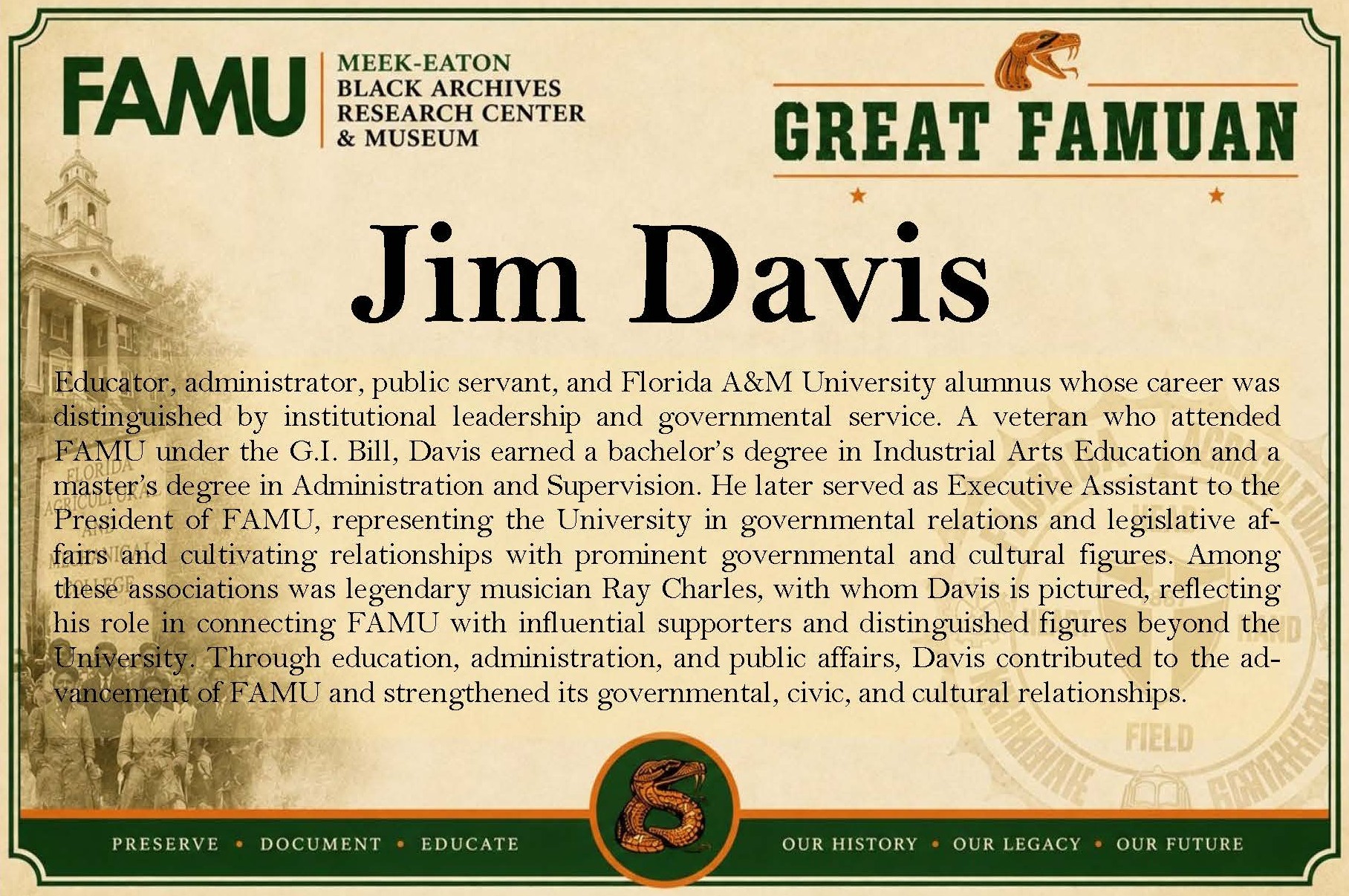
Jim Davis
-
Alternative Title
-
James Arthur "Jim" Davis
-
Category
-
Civil Service
-
Affiliation to FAMU
-
Alumni
-
Life at FAMU
-
Distinguished alumnus, educator, administrator, and public servant whose relationship with Florida A&M University evolved from student to senior institutional representative. His career reflected a sustained commitment to the advancement of his alma mater and placed him at the intersection of higher education, governmental relations, legislative affairs, and community engagement.
A veteran, Davis enrolled at Florida A&M through the educational opportunities provided by the G.I. Bill. His experience belonged to a transformative period in American higher education when returning veterans increasingly pursued college degrees following military service. For African American veterans, historically Black colleges and universities such as Florida A&M were particularly important because segregation continued to restrict access to many predominantly white institutions.
At Florida A&M, Davis pursued studies in Industrial Arts Education, earning his bachelor's degree in the field. Industrial arts represented an important component of the institution's historic commitment to mechanical, vocational, and technical education. The discipline combined practical and technical preparation with professional education, preparing graduates to teach subjects requiring knowledge of materials, tools, design, production, craftsmanship, and industrial processes.
Davis later returned to graduate study at FAMU and earned a master's degree in Administration and Supervision. This advanced preparation broadened his professional expertise beyond classroom instruction and equipped him with knowledge related to educational leadership, organizational administration, personnel management, institutional planning, and supervision.
His academic progression—from industrial arts education to administration—anticipated the broader trajectory of his professional career. The technical and pedagogical preparation of his undergraduate education was complemented by graduate training that prepared him for increasingly significant administrative responsibilities.
Davis eventually returned to serve the institution that had educated him, ultimately concluding his distinguished career as Executive Assistant to the President of Florida A&M University. In this senior administrative capacity, he served as an official University representative in governmental relations and legislative affairs.
His responsibilities placed him at an important intersection between FAMU and Florida's governmental leadership. As a public university, Florida A&M's growth and development were closely connected to decisions involving state appropriations, capital projects, academic initiatives, public policy, and legislative support. Maintaining productive relationships with elected officials and governmental leaders was therefore essential to advancing the University's institutional priorities.
Davis helped communicate those priorities to policymakers and external stakeholders. His work required both a detailed understanding of the University's needs and an ability to navigate the structures and relationships of state government. Through this role, he contributed to the institutional advocacy necessary to support FAMU's educational mission.
His governmental-relations work also placed him in contact with influential figures in Florida public life, including state legislators such as Senator Pat Thomas. Such relationships were important to the University's ability to communicate its priorities and strengthen support for its programs, students, facilities, and broader institutional mission.
Davis's work also extended into relationships with prominent cultural figures associated with Florida A&M. Among the individuals with whom he is documented photographically was legendary musician Ray Charles. The image of Davis with Charles provides an important visual record of the University's engagement with nationally recognized cultural figures and supporters.
Ray Charles developed a meaningful association with Florida A&M, and his name ultimately became permanently connected with the University through the Ray Charles Performing Arts Center. Within this broader institutional history, Davis's documented appearance with Charles reflects the external-facing dimension of his administrative responsibilities and the networks of cultural, civic, governmental, and philanthropic relationships surrounding the University.
The photograph is particularly valuable as an interpretive object because it illustrates a dimension of university administration that is often less visible in the historical record. Senior administrators responsible for governmental and external relations frequently serve as institutional ambassadors, connecting universities with public officials, cultural leaders, donors, alumni, and community stakeholders.
Davis's career demonstrates the importance of this work to FAMU. His responsibilities were not confined to internal administration; rather, he represented the University in environments where institutional priorities, public policy, cultural relationships, and community interests intersected.
His progression from student to senior administrator also embodies a longstanding tradition within historically Black higher education. Generations of FAMU alumni have returned to their alma mater as educators, administrators, advocates, and benefactors, reinvesting their professional knowledge in the institution that helped prepare them.
Davis's relationship with FAMU therefore extended across multiple dimensions of his life. The University provided his undergraduate and graduate education, prepared him for professional leadership, and ultimately became the institution he represented at the highest levels of governmental and external affairs.
His career also demonstrates the transformative possibilities created by higher education for African American veterans. Through the G.I. Bill and the educational opportunities available at Florida A&M, Davis moved from military service into higher education and subsequently into educational administration and institutional leadership.
As Executive Assistant to the President, Davis became part of the administrative infrastructure responsible for ensuring that Florida A&M's interests were effectively represented before governmental leaders. His service contributed to the relationships upon which public institutions depend for legislative understanding, financial support, policy development, and long-term growth.
James Arthur “Jim” Davis should consequently be remembered as more than a University administrator. He was a FAMU alumnus who transformed the educational opportunities he received into a career of service to his alma mater. Through governmental relations, legislative affairs, institutional advocacy, and relationships with influential public and cultural figures—including his documented association with Ray Charles—Davis helped extend FAMU's presence beyond the campus and strengthen its connections throughout Florida and beyond.
His legacy reflects a reciprocal relationship between an alumnus and his institution: Florida A&M helped prepare Davis for professional leadership, and Davis subsequently devoted his experience and expertise to advancing Florida A&M. His journey from G.I. Bill student to Executive Assistant to the President represents a distinguished chapter in the University's tradition of education, service, leadership, and institutional stewardship.
-
Life Bio
-
Educator, administrator, veteran, and public servant whose professional career reflected a sustained commitment to education, organizational leadership, and public affairs. A native of Apopka, Florida, Davis belonged to a generation of African American professionals whose careers developed during a period of profound transformation in American education, government, and race relations.
Military service formed an important part of Davis's early adulthood and preceded his pursuit of higher education through the G.I. Bill. The legislation dramatically expanded educational opportunities for returning veterans, enabling many former servicemen and women to pursue college degrees and professional training.
For African American veterans, however, access to these benefits remained shaped by the realities of segregation. Historically Black colleges and universities became especially important avenues through which Black veterans could use their educational benefits, acquire professional credentials, and prepare for careers that had previously been difficult to enter because of racial discrimination.
Davis pursued professional preparation in Industrial Arts Education. This field combined technical expertise with teacher education and emphasized practical problem-solving, craftsmanship, design, technology, and industrial processes. His training prepared him to participate in the educational system not simply as a practitioner of technical skills but as an educator capable of transmitting those skills to others.
He subsequently expanded his professional preparation through graduate study in Administration and Supervision. The combination of teaching and administrative education equipped Davis with a broad understanding of educational organizations, from classroom instruction and curriculum to personnel management, institutional leadership, and organizational planning.
His career ultimately developed beyond traditional educational administration into governmental and legislative affairs. This progression reflected an ability to translate educational leadership into public service and institutional advocacy.
Governmental relations requires a distinctive combination of skills. Professionals working in this area must understand public institutions, communicate effectively with elected officials and governmental agencies, interpret legislative developments, cultivate professional relationships, and represent organizational priorities with clarity and diplomacy. Davis's educational and administrative background provided a strong foundation for these responsibilities.
Throughout his career, he developed relationships with individuals in government, education, and public life. His association with figures such as Florida legislator Pat Thomas illustrates his engagement with the governmental networks through which public policy and institutional priorities were discussed and advanced.
His documented appearance with internationally renowned musician Ray Charles similarly reflects the breadth of his professional environment. While Davis's relationship with Charles should not be overstated beyond the available historical evidence, the surviving photograph provides a meaningful record of his interaction with one of the most significant American musicians of the twentieth century.
Such encounters demonstrate the range of constituencies that experienced administrators and institutional representatives could engage throughout their careers. Government officials, cultural figures, educators, community leaders, and supporters frequently occupied overlapping networks of institutional advocacy and public engagement.
Davis's professional development is particularly noteworthy because it encompassed several forms of service. He was trained as an educator, prepared as an administrator, experienced as a veteran, and ultimately entrusted with responsibilities involving governmental and legislative relations.
These roles shared a common foundation in communication and leadership. Educators communicate knowledge; administrators coordinate people and institutions; governmental-relations professionals interpret organizational priorities for public officials; and public servants cultivate relationships necessary to accomplish institutional goals. Davis's career brought these functions together.
His professional life also represents the increasing presence of African American administrators within public institutions during the latter half of the twentieth century. The period through which Davis's career developed witnessed the dismantling of formal segregation alongside continuing struggles over educational equality, representation, institutional resources, and access to professional leadership.
African American administrators operating within this environment frequently carried responsibilities that extended beyond conventional job descriptions. Their work could involve navigating changing political environments, advocating for historically Black institutions, developing relationships with governmental leaders, and ensuring that the needs of Black students and communities remained visible within public decision-making.
Davis's career should therefore be interpreted within this larger history of African American professional advancement and public service. His achievements reflected individual preparation and leadership while also representing the expanding opportunities created by generations who challenged barriers within education and government.
His life additionally illustrates the long-term significance of veterans' educational opportunities. The G.I. Bill provided Davis with a pathway into higher education, but the significance of that opportunity extended far beyond earning a degree. Education became the foundation for a career through which he could teach, administer, represent institutions, and participate in governmental affairs.
Over the course of his professional life, Davis developed from a technically trained educator into an experienced administrator and institutional advocate. His career demonstrates that professional preparation can create pathways extending well beyond the discipline in which an individual initially studies.
James Arthur “Jim” Davis died on March 17, 2016, at the age of eighty-six. His life encompassed military service, education, administration, governmental relations, and public engagement, leaving a record of professional achievement grounded in service and institutional responsibility.
His legacy is best understood through the continuity connecting these experiences. Military service preceded educational opportunity; education provided professional preparation; professional preparation developed into administrative leadership; and administrative experience ultimately supported a career involving governmental and public affairs.
James Arthur “Jim” Davis thus represents a generation of African American educators and administrators who transformed educational opportunity into sustained public service. His professional journey—from veteran and student to educator, administrator, and governmental-relations leader—reflects the importance of education as both a means of personal advancement and a foundation for service to institutions and communities.
-
Artifact Dimensions
-
L x W: 57.15 x 46.99
-
Medium
-
Photograph, dark wood frame
-
Rights
-
All rights reserved. The use of any part of these objects and photographs transmitted in any form by any means, electronic, mechanical, photocopying, recording, or otherwise, or stored in a retrieval system without the prior written consent of Meek-Eaton Black Archives is an infringement of the copyright law.
-
Rights Holder
-
Meek - Eaton Southeastern Regional Black Archives Research Center and Museum