-
Title
-
Jackson Davis
-
Birth Date
-
September 25, 1882
-
Transition Date
-
April 15, 1947
-
Category
-
Education
-
Affiliation to FAMU
-
Institutional Supporter
-
Life at FAMU
-
Although Davis was not a graduate or faculty member of Florida A&M, his professional work brought him into a significant relationship with the institution during a formative period in its development.
During the early twentieth century, Florida A&M operated within a segregated system of public higher education that provided substantially unequal resources to institutions serving African Americans. As the College expanded its programs in teacher preparation, agriculture, mechanical education, and other professional fields, institutional leaders confronted persistent challenges involving facilities, equipment, faculty support, and funding.
Davis's work in educational philanthropy positioned him to assist institutions confronting precisely these challenges. Through his associations with organizations supporting Southern education, particularly the General Education Board, he became part of a network through which historically Black schools and colleges could secure resources to supplement inadequate public appropriations.
His relationship with Florida A&M developed within this larger effort to strengthen African American education. Davis advocated for educational advancement and helped facilitate philanthropic attention and financial support for Black institutions. Such assistance was especially consequential during a period when historically Black colleges were simultaneously expanding their academic ambitions and operating within political systems structured by racial inequality.
Florida A&M's importance extended well beyond the students enrolled on its campus. As one of Florida's principal institutions for the higher education of African Americans, the College prepared teachers and other professionals who subsequently served communities throughout the state. Supporting FAMC therefore represented an investment not only in one institution but also in a broader network of African American schools and communities.
Teacher preparation was particularly central to this relationship. Improvements in collegiate education could have a multiplying effect because graduates entered elementary and secondary schools as teachers and administrators. Strengthening Florida A&M consequently strengthened the professional preparation of educators whose influence extended across generations of African American students.
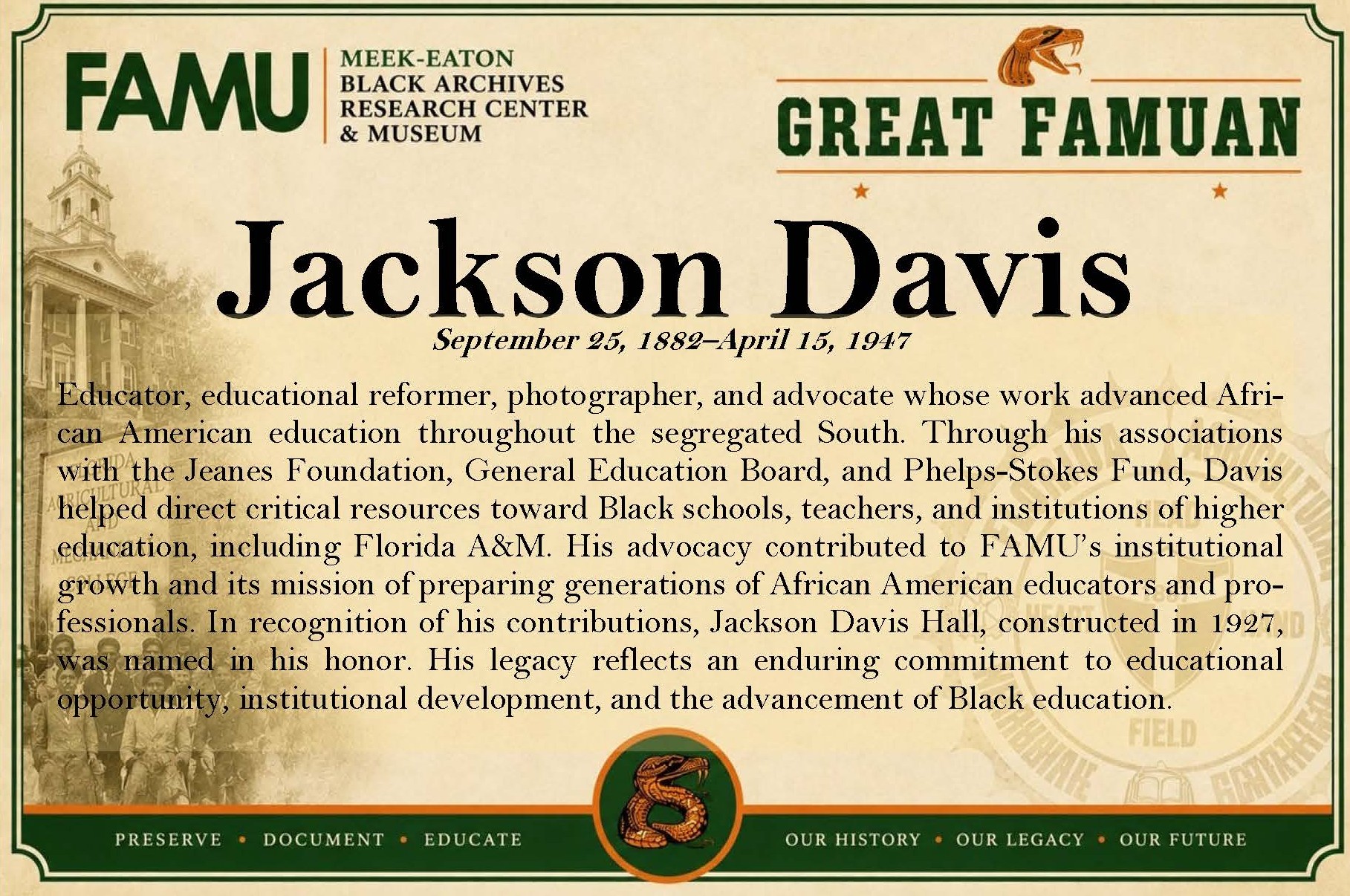
Davis's contribution to the institution was recognized in a particularly visible manner with the construction of Jackson Davis Hall in 1927. The naming of a campus building in his honor represented a significant institutional acknowledgment of his advocacy and support for African American educational development.
Jackson Davis Hall became part of the physical landscape through which Florida A&M expressed its growth and permanence. Campus buildings were more than functional spaces; they represented the institution's expanding capacity to educate students and develop academic programs. For a Black college operating under segregation, improvements to the physical campus also demonstrated institutional resilience and aspiration despite persistent inequalities in public funding.
The naming of the building during Davis's lifetime suggests the esteem associated with his educational work and his relationship with the College. His name became embedded within the physical and historical landscape of Florida A&M, linking his broader work in Southern education with the development of the institution.
Davis's relationship with FAMU also provides insight into the complex financial environment in which historically Black colleges operated. Black institutions frequently depended upon combinations of public appropriations, tuition, community support, private philanthropy, and partnerships with educational foundations. Individuals capable of connecting institutions with philanthropic organizations therefore occupied influential positions in the development of Black higher education.
These relationships must also be interpreted within their historical context. Philanthropic organizations could provide essential resources while simultaneously exercising considerable influence over educational priorities. African American college presidents and educators often had to navigate these relationships carefully, securing urgently needed support while pursuing their own institutional visions for Black higher education.
Within this environment, Davis served as an intermediary between educational institutions and organizations possessing the resources to support them. His familiarity with the conditions of Black education enabled him to communicate institutional needs and advocate for investments in schools and colleges.
His photographic work further complemented this educational mission. Through photographs of African American schools, students, teachers, and communities, Davis documented educational conditions throughout the South. These images created a visual record of both the inequalities confronting Black education and the determination of African American communities to build and sustain institutions despite limited resources.
Florida A&M's association with Davis therefore connects the University's history to a much larger story of African American educational development. The College was part of a regional network of Black institutions whose advancement depended upon educators, administrators, communities, public resources, and philanthropic support.
Davis's legacy at Florida A&M ultimately rests upon institutional advocacy rather than classroom teaching or alumni affiliation. He contributed to an environment in which the College could strengthen its facilities and educational mission during a period of profound racial inequality.
The continued historical association of his name with Jackson Davis Hall preserves this relationship. It reminds subsequent generations that the development of Florida A&M was shaped not only by presidents, faculty, students, and alumni but also by advocates who helped direct attention and resources toward the advancement of African American higher education.
Jackson Davis's place in FAMU history should therefore be understood as that of an educational advocate and institutional supporter. Through his broader work on behalf of Black education and his relationship with Florida A&M, he contributed to the University's growth during a formative period and helped strengthen an institution that would educate generations of African American teachers, professionals, scholars, and leaders.
-
Life Bio
-
Educator, educational reformer, photographer, and philanthropic administrator whose career was devoted to the advancement and documentation of African American education in the South. Working during the height of Jim Crow segregation, Davis traveled extensively throughout Southern communities and became an important intermediary among schools, educators, public officials, and philanthropic organizations seeking to improve educational opportunities for Black students.
Born in Virginia in 1882, Davis came of age during a period in which the political and social gains African Americans had achieved during Reconstruction were being systematically undermined. Segregation, disfranchisement, racial violence, and discriminatory public policies shaped virtually every aspect of Southern life, including education.
Public schools serving African American children routinely received substantially fewer resources than schools serving white students. Black teachers frequently worked with inadequate buildings, limited instructional materials, overcrowded classrooms, and unequal salaries. Rural communities confronted particularly severe educational inequalities.
Davis began his professional life as an educator, gaining firsthand experience with the circumstances confronting schools and teachers. This practical knowledge became important as his career expanded from direct educational work into administration, supervision, philanthropy, and educational reform.
His professional development became closely associated with the Jeanes Foundation, one of the important philanthropic initiatives supporting African American rural education in the South. The Jeanes program became known particularly for its network of supervising teachers, often called Jeanes teachers, who traveled among rural Black schools assisting teachers, strengthening instruction, developing community programs, and encouraging improvements to school facilities.
Through this work, Davis encountered African American education at the community level. He observed the conditions in which students learned and teachers worked, while also witnessing the considerable sacrifices Black families and communities made to sustain educational institutions.
These experiences shaped his understanding that improving education required more than classroom instruction. Schools needed trained teachers, appropriate facilities, instructional materials, administrative support, sustainable financing, and community participation. His subsequent career addressed these interconnected needs.
Davis eventually became associated with the General Education Board, an influential philanthropic organization established through the support of John D. Rockefeller. The Board invested substantial resources in education throughout the United States and became particularly involved in educational development in the South.
His position within philanthropic networks enabled him to advocate for schools and colleges that often lacked adequate public resources. He traveled, assessed institutional conditions, communicated with educators and administrators, and helped connect educational needs with potential financial support.
Davis also maintained professional relationships with the Phelps-Stokes Fund, another organization influential in the study and development of African and African American education. His work across these networks placed him within an important community of twentieth-century educational reformers concerned with teacher preparation, rural schooling, vocational education, higher education, and institutional development.
The philanthropic system within which Davis operated was complex. Private foundations provided resources that could make substantial improvements possible, but they also possessed considerable influence over educational policy. Black educators and institutions therefore navigated a system in which urgently needed financial support could coexist with outside assumptions about the appropriate direction of African American education.
Davis's career should be interpreted within this tension. His work contributed materially to Black educational development, but it took place within the broader paternalistic and segregated structures that characterized much of Southern educational policy during the period.
One of Davis's most historically valuable professional practices was photography. During his extensive travels, he photographed African American schools, teachers, students, buildings, agricultural activities, and community life.
These photographs have become an important documentary record of African American education during the first half of the twentieth century. They preserve visual evidence of school buildings and educational environments that might otherwise have disappeared from the historical record.
His images documented severe inequalities, including modest and inadequately equipped rural schools, while also capturing the determination of Black educators and communities to create meaningful educational opportunities. Students, teachers, classrooms, school grounds, and community activities appear not simply as subjects of institutional reports but as participants in a complex history of educational aspiration.
Photography thus complemented Davis's administrative work. His camera provided a mechanism for recording the conditions he observed and communicating the circumstances of African American education to audiences who might otherwise have had little direct knowledge of Black schools.
His photographs today possess significance beyond the purposes for which they were originally created. Historians use them to examine architecture, clothing, classroom practices, agricultural education, school communities, childhood, race relations, and the material conditions of Southern education.
Davis's professional career also reflected the increasing importance of educational administration and supervision during the early twentieth century. Reformers increasingly emphasized systematic planning, professional teacher preparation, school supervision, curriculum development, and institutional assessment.
His work helped connect these emerging professional practices with the specific challenges facing African American schools. By traveling extensively and developing relationships with local educators, he occupied a position from which he could observe both broad regional patterns and the distinctive circumstances of individual communities.
Davis was particularly concerned with strengthening the institutional foundations upon which education depended. His advocacy encompassed schools and colleges because he recognized the interconnected nature of educational development. Colleges prepared teachers; teachers strengthened schools; stronger schools prepared students for advanced education; and educated graduates returned to communities as professionals and leaders.
His work with historically Black colleges was therefore part of a broader strategy for developing educational capacity. Strengthening institutions of higher education created pathways through which African Americans could become teachers, administrators, agricultural specialists, skilled professionals, and community leaders.
Davis's professional life ultimately extended across several interconnected identities: educator, supervisor, administrator, philanthropic representative, reformer, advocate, and documentary photographer. Each reflected a different dimension of his central commitment to education.
He died on April 15, 1947, after several decades of work during one of the most consequential periods in the history of African American education. His career preceded the major legal victories of the modern Civil Rights Movement, including the dismantling of legally segregated public education, yet the institutions and educators he supported helped create foundations upon which later generations would build.
His photographic archive remains one of the most distinctive elements of his legacy. The images he created preserve a visual history of African American educational life that complements written records and provides subsequent generations with direct evidence of the schools, teachers, students, and communities that shaped Black education.
Jackson Davis should therefore be remembered as an important figure in the history of Southern educational reform whose work combined institutional advocacy with historical documentation. His career reveals both the possibilities and complexities of philanthropic intervention in African American education during segregation.
Through education, administration, philanthropy, advocacy, and photography, Davis helped direct attention and resources toward Black educational institutions while preserving an extraordinary record of the communities they served. His legacy remains significant not only for the schools and colleges that benefited from his work, but also for the documentary evidence he left behind of African Americans' persistent pursuit of education in the face of profound inequality.
-
Artifact Dimensions
-
L x W: 15.25 x 12.25in (38.74 x 31.12cm)
-
Medium
-
Photograph, Gold decorative frame with carved styled embellishments
-
Rights
-
All rights reserved. The use of any part of these objects and photographs transmitted in any form by any means, electronic, mechanical, photocopying, recording, or otherwise, or stored in a retrieval system without the prior written consent of Meek-Eaton Black Archives is an infringement of the copyright law.
-
Rights Holder
-
Meek - Eaton Southeastern Regional Black Archives Research Center and Museum