-
Title
-
George W. Conoly
-
Alternative Title
-
George "Mr. Alumni" Conoly
-
Birth Date
-
1902
-
Transition Date
-
1980
-
Category
-
Education
-
Affiliation to FAMU
-
Faculty
-
Life at FAMU
-
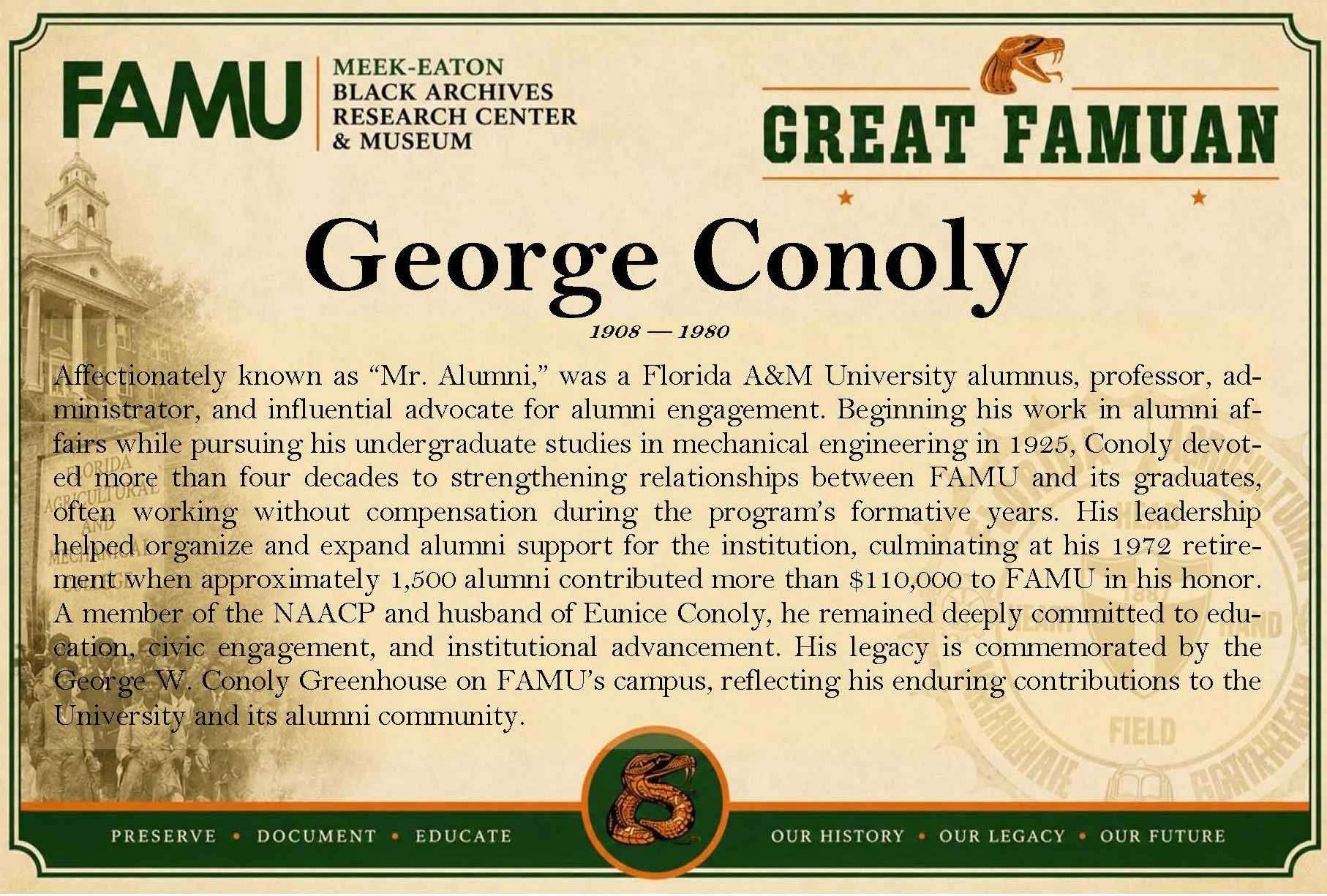
Educator, engineer, professor, administrator, and alumni advocate whose extraordinary devotion to Florida Agricultural and Mechanical College—later Florida A&M University—helped strengthen generations of alumni engagement and institutional support. Affectionately known among his contemporaries as **“Mr. Alumni,”** Conoly devoted much of his professional life to cultivating the relationship between FAMU and its graduates. Over more than four decades of service, he helped transform alumni affairs into an important vehicle for institutional advocacy, fundraising, fellowship, and enduring loyalty to the University.
Conoly's relationship with Florida A&M began during a formative period in the institution's history. In 1925, while pursuing his undergraduate education in mechanical engineering, he began working in alumni affairs. At the time, the institution was known as Florida Agricultural and Mechanical College for Negroes and was developing its academic programs and physical campus within the restrictive environment of racial segregation.
Historically Black colleges and universities during this period operated under profound financial and political inequalities. Public appropriations for Black institutions were routinely inadequate when compared with those provided to white institutions, making alumni support, private philanthropy, and community advocacy particularly important to institutional survival and growth. Within this environment, Conoly recognized that graduates could become one of Florida A&M's most important constituencies.
His early alumni work was characterized by extraordinary personal commitment. Conoly reportedly performed some of his initial alumni organizing without compensation, demonstrating a dedication to the institution that extended beyond the requirements of formal employment. He worked to locate graduates, maintain relationships with former students, encourage alumni participation, and foster a stronger sense of collective responsibility toward the College.
This work required persistence. During the early twentieth century, alumni were geographically dispersed, and institutions lacked the instantaneous communication technologies available today. Building an effective alumni network depended upon correspondence, personal relationships, meetings, travel, alumni chapters, publications, and sustained individual contact. Conoly's ability to cultivate these relationships helped bring FAMU graduates into a more organized and active community.
His undergraduate preparation in mechanical engineering reflected another important dimension of Florida A&M's educational mission. Agricultural, mechanical, industrial, and technical education had been central to the institution's development, and programs in these fields prepared African American students for professional and technical careers at a time when racial discrimination severely restricted educational and employment opportunities.
Following his education, Conoly's professional relationship with Florida A&M continued to deepen. He served the institution as a professor as well as an alumni affairs officer, combining responsibilities for education with the cultivation of relationships among graduates. His dual role positioned him uniquely within the FAMU community: he helped educate students while simultaneously building the networks through which those students could remain connected to their alma mater after graduation.
Over the course of approximately forty-two years of service, Conoly became one of the University's most recognizable advocates for alumni participation. His work helped establish the principle that graduation did not end an individual's relationship with Florida A&M. Rather, alumni could continue to serve the institution as ambassadors, advocates, mentors, donors, and organized supporters.
Conoly's reputation eventually earned him the affectionate designation **“Mr. Alumni.”** The nickname reflected more than longevity. It represented the degree to which alumni affairs at Florida A&M became identified with his personality, dedication, and institutional loyalty. For generations of graduates, Conoly served as a continuing connection between their individual experiences and the larger FAMU community.
His career spanned an extraordinary period of institutional and social transformation. He witnessed Florida A&M's evolution from Florida Agricultural and Mechanical College for Negroes to Florida Agricultural and Mechanical College and, in 1953, to Florida Agricultural and Mechanical University. Each stage reflected the institution's expanding academic mission and increasing complexity.
Conoly also served through decades encompassing the Great Depression, World War II, the postwar expansion of American higher education, the modern Civil Rights Movement, and the desegregation of public institutions. Throughout these transformations, alumni advocacy remained essential to preserving and advancing FAMU's mission.
The political importance of alumni engagement was especially pronounced for historically Black institutions. Alumni could advocate for their alma mater within local communities, professional organizations, government, business, and civic life. A strong alumni association therefore represented not merely a social organization but an important network of institutional influence.
Conoly worked to cultivate this broader understanding of alumni responsibility. His efforts encouraged graduates to view themselves as stakeholders in the University's future. Through participation, financial contributions, and advocacy, alumni could help protect and expand the institution that had provided their education.
Fundraising became an important expression of this commitment. Conoly understood that alumni giving could provide both material resources and symbolic evidence of confidence in the institution. Contributions from graduates demonstrated that those who had benefited from FAMU were willing to reinvest in its continued development.
The strength of the alumni culture Conoly helped foster became especially visible upon his retirement in 1972. Approximately 1,500 alumni reportedly joined together in a remarkable demonstration of appreciation and institutional loyalty, contributing approximately **$110,430 to Florida A&M University**. The campaign represented a substantial financial commitment and illustrated the depth of the alumni network Conoly had spent decades cultivating.
Beyond its monetary value, the retirement campaign represented an important statement about collective responsibility. Rather than simply honoring Conoly personally, alumni directed their generosity toward the institution to which he had devoted his career. In doing so, they transformed recognition of an individual into an investment in FAMU's future.
The response was particularly appropriate to Conoly's professional philosophy. His life's work had been centered upon encouraging alumni to support their alma mater, and his retirement became an occasion on which graduates demonstrated that the culture of engagement he promoted had taken root.
Conoly's institutional influence extended beyond fundraising. Effective alumni relations helped preserve traditions, strengthen communication across generations, maintain institutional memory, and connect graduates with current students. Alumni organizations could also provide professional networks and mentorship opportunities while reinforcing a shared sense of identity.
Through this work, Conoly helped nurture what would become one of FAMU's defining characteristics: the enduring loyalty of its graduates. The University's alumni community has historically played a significant role in defending the institution, promoting its accomplishments, supporting students, and advocating for its continued development.
Conoly's life was also grounded in family and civic engagement. He was married to **Eunice Conoly**, with whom he shared his life during his many years of service to Florida A&M. His personal commitments existed alongside a professional career deeply embedded within the University and the broader African American community.
He was also associated with the **National Association for the Advancement of Colored People (NAACP)**, placing his civic engagement within the larger twentieth-century movement for African American civil rights and advancement. Membership in organizations such as the NAACP reflected the interconnected nature of education, civic participation, and racial progress during an era when Black institutions and communities confronted systemic discrimination.
For African American educators of Conoly's generation, professional service frequently carried broader social significance. Strengthening a historically Black university was itself an important contribution to racial advancement because institutions such as FAMU provided educational opportunities, professional preparation, leadership development, and intellectual community that segregation sought to restrict.
Conoly's work therefore operated simultaneously at institutional and community levels. By strengthening FAMU's alumni network, he helped reinforce an institution that served as a major center of African American education and leadership in Florida and throughout the nation.
After more than four decades of service, Conoly retired in 1972. His retirement marked the conclusion of a remarkable professional tenure but not the end of his influence. The alumni structures, traditions of giving, and culture of institutional loyalty that he had promoted continued beyond his formal employment.
George W. Conoly died in 1980, leaving behind a legacy deeply connected to Florida A&M University. His influence was remembered not simply through administrative records but through the generations of alumni whose relationship with the institution had been strengthened through his work.
Recognition of his contributions continued after his death. In 1985, former Florida governor **LeRoy Collins** supported efforts to memorialize Conoly's service through the naming of a greenhouse on the Florida A&M campus in his honor. The **George W. Conoly Greenhouse** preserved his name within the physical landscape of the University he had served for decades.
The naming carried particular significance because Conoly's career had been devoted to cultivating institutional growth. A greenhouse—a place associated with cultivation, development, and sustained care—provides an especially fitting memorial for an individual whose life's work centered upon nurturing relationships between FAMU and generations of its graduates.
Conoly's legacy is ultimately inseparable from the history of alumni engagement at Florida A&M University. Beginning his alumni work while still a student, serving during periods when compensation and institutional resources were limited, and continuing for approximately forty-two years, he helped establish alumni relations as an enduring component of University life.
His designation as **“Mr. Alumni”** consequently represented more than an affectionate nickname. It recognized a lifetime devoted to building relationships, encouraging philanthropy, strengthening institutional loyalty, and reminding graduates that their responsibility to Florida A&M could continue throughout their lives.
George W. Conoly should therefore be remembered as one of FAMU's important institutional builders. His contribution was not primarily the construction of a building or the creation of an academic discipline, but the cultivation of a community. By organizing and inspiring alumni, he helped transform individual graduates into a collective constituency capable of advocating for and investing in Florida A&M.
His life embodied the reciprocal relationship between an institution and its alumni. Florida A&M provided Conoly with his education and professional home; in return, he devoted decades to strengthening the University's relationship with those it educated. The extraordinary alumni response at his retirement and the later memorialization of his name on campus testify to the lasting impact of that service.
Through teaching, administration, alumni relations, civic engagement, and institutional advocacy, George W. Conoly helped establish traditions of loyalty and collective support that became integral to the FAMU experience. His legacy as “Mr. Alumni” remains a testament to the power of alumni engagement in sustaining historically Black higher education and to one individual's enduring commitment to the advancement of Florida A&M University.
-
Life Bio
-
Professional life reflected a sustained commitment to education and community advancement. His career developed during an era when African American professionals confronted the structural inequalities of segregation while simultaneously building and strengthening institutions that provided opportunities for Black communities.
Conoly pursued higher education in mechanical engineering, a field that reflected his interest in technical and scientific preparation. For African American students during the early twentieth century, access to professional and technical education carried particular importance. Segregation restricted admission to many institutions and limited professional opportunities, making historically Black colleges essential centers for developing African American engineers, educators, scientists, and other professionals.
Although technically trained, Conoly's professional life ultimately expanded beyond engineering into education, administration, and institutional development. He became a professor and spent much of his career working with students and graduates, combining the intellectual responsibilities of an educator with the organizational skills of an administrator.
Teaching formed an important dimension of his professional identity. As a professor, Conoly belonged to a generation of African American educators who understood higher education not simply as preparation for individual careers but as an instrument for community advancement. Black colleges trained professionals who frequently returned to their communities as teachers, businesspeople, public servants, civic leaders, and advocates.
Conoly's work in alumni affairs further broadened his professional influence. Alumni administration required sustained communication, organizational leadership, fundraising, event coordination, relationship-building, and institutional advocacy. Through these responsibilities, he developed a professional career centered upon cultivating communities and encouraging individuals to participate collectively in the advancement of education.
His extraordinary commitment to this work was evident in his willingness to perform alumni-related responsibilities without compensation during portions of his early career. Such service reflected an understanding of institutional work as something extending beyond formal employment. For Conoly, strengthening an educational institution was a form of service to a broader community.
His professional philosophy emphasized collective responsibility. He encouraged graduates to understand that educational opportunity carried with it an obligation to support institutions capable of extending similar opportunities to future generations. Through this approach, alumni giving and participation became forms of intergenerational investment.
Conoly's civic commitments also extended beyond higher education. He was associated with the National Association for the Advancement of Colored People (NAACP), connecting his life with the broader movement for African American civil rights and social advancement. During the decades in which he lived and worked, the NAACP played a critical role in challenging racial discrimination, unequal educational opportunities, disfranchisement, and segregation.
His involvement with the organization reflected the interconnected nature of education and civil rights during the twentieth century. Strengthening Black educational institutions and challenging discriminatory systems were complementary dimensions of the larger struggle for African American advancement.
Conoly's personal life was shared with his wife, Eunice Conoly. Their partnership accompanied a professional career characterized by decades of educational and institutional service. Like many families associated with historically Black colleges, their lives unfolded within a community in which professional responsibilities, civic relationships, social networks, and university life frequently intersected.
Throughout his career, Conoly became known for qualities of persistence, loyalty, and service. His effectiveness rested not simply upon administrative authority but upon his ability to build and sustain relationships. These interpersonal connections allowed him to bring individuals together around a shared commitment to education and institutional advancement.
His professional life also illustrates the important role played by African American educators and administrators in building durable institutions during segregation. Historically Black colleges were sustained not solely by presidents or major benefactors but by generations of faculty members, staff, alumni organizers, community advocates, and families whose daily work strengthened institutional foundations.
Conoly belonged to this tradition of institution-building. His contribution was particularly centered upon developing human networks—the relationships among students, graduates, educators, civic leaders, and supporters that allowed an institution to extend its influence beyond its physical campus.
After decades of professional service, Conoly retired in 1972. The extraordinary response surrounding his retirement demonstrated the respect he had earned and the influence of his career. The collective financial contribution made in his honor reflected the success of a professional philosophy based upon loyalty, participation, and giving.
George W. Conoly died in 1980, leaving a legacy grounded in education, civic engagement, and institutional service. His career demonstrates how an individual trained in one professional discipline could ultimately exercise influence across education, administration, philanthropy, and community life.
Remembered affectionately as “Mr. Alumni,” Conoly exemplified a model of leadership rooted in sustained service rather than personal prominence. His professional achievements were measured not simply by positions held but by relationships created, individuals inspired, and institutions strengthened.
His life ultimately represents an important chapter in the history of African American educational leadership during the twentieth century. As an educator, administrator, NAACP member, husband, and advocate for higher education, George W. Conoly devoted his talents to strengthening institutions and encouraging collective investment in future generations. His legacy reflects the enduring power of education, service, civic responsibility, and institutional loyalty.
-
Artifact Dimensions
-
L x W: 53.34 x 43.18
-
Medium
-
Graphite on paper, medium brown frame
-
Rights
-
All rights reserved. The use of any part of these objects and photographs transmitted in any form by any means, electronic, mechanical, photocopying, recording, or otherwise, or stored in a retrieval system without the prior written consent of Meek-Eaton Black Archives is an infringement of the copyright law.
-
Rights Holder
-
Meek - Eaton Southeastern Regional Black Archives Research Center and Museum