-
Title
-
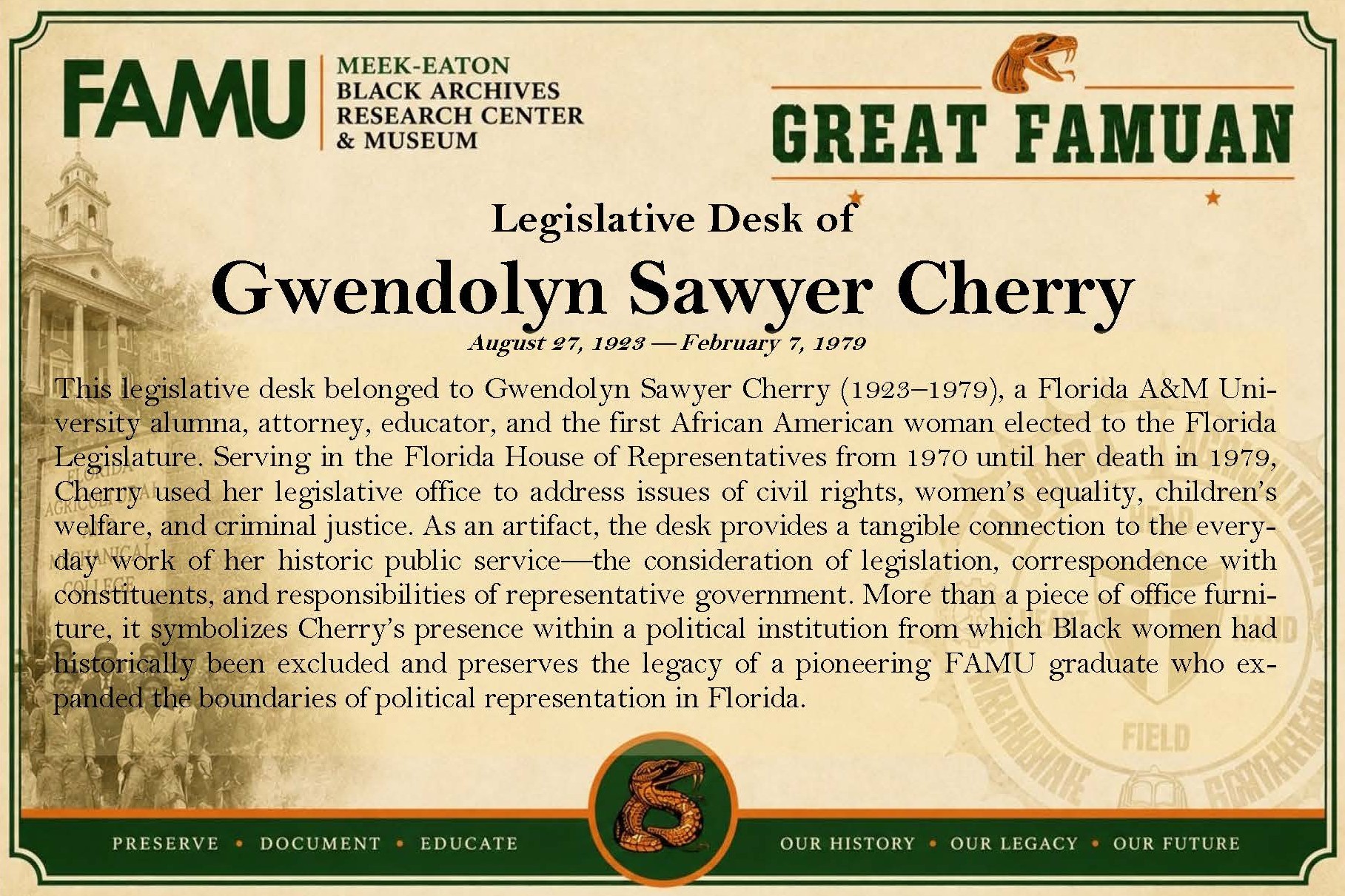
Gwendolyn Sawyer Cherry Legislative Desk
-
Alternative Title
-
Representative Gwendolyn Sawyer Cherry
-
Birth Date
-
August 27, 1923
-
Transition Date
-
February 7, 1979
-
Category
-
Civil Service
-
Affiliation to FAMU
-
Alumna
-
Life at FAMU
-
A native of Miami, Cherry entered Florida Agricultural and Mechanical College during an era when historically Black colleges and universities provided essential pathways to higher education and professional advancement for African Americans confronting the restrictions of segregation.
Cherry earned her undergraduate degree from Florida A&M in 1946, studying biology and chemistry. Her education provided an academic foundation for a career that would ultimately encompass teaching, law, civic leadership, and elected public service. She subsequently earned a master’s degree from New York University before returning to Florida, where she spent more than two decades in education.
Her relationship with FAMU assumed even greater historical significance when she pursued legal education. The original Florida A&M College of Law had been established in 1949 and admitted its first class in 1951, providing state-supported legal education for African Americans during segregation. The original law school ultimately produced only fifty-seven graduates between 1954 and 1968, making its alumni a particularly consequential group within the history of African American legal education in Florida.
Cherry became one of those pioneering graduates, earning her law degree from FAMU in 1965. A surviving 1964 photograph from the original College of Law documents Cherry among fellow law students on the steps of the law school in Tallahassee, providing a visual record of her place within this historic generation of FAMU-trained attorneys.
Her legal education at FAMU became foundational to the next phase of her professional life. Cherry went on to become Dade County’s first Black woman attorney and subsequently entered public service, carrying into her career the educational preparation and service-oriented tradition associated with her alma mater.
Cherry’s achievements also illustrate the broader historical importance of FAMU’s original College of Law. Its graduates entered a profession in which African Americans—and particularly African American women—remained severely underrepresented. Through their careers as attorneys, judges, elected officials, and public servants, the original graduates demonstrated the importance of access to legal education in expanding Black participation within the institutions of law and government. FAMU today recognizes those fifty-seven graduates as pioneers whose careers established a legacy of transformative service.
Cherry’s relationship with FAMU therefore extended well beyond the conferral of her degrees. Her subsequent accomplishments brought distinction to the institution and demonstrated the potential of a FAMU education to prepare graduates for leadership in professions and public institutions from which African Americans had historically been excluded.
Her legacy continues within the reestablished Florida A&M University College of Law. The College has memorialized her through the Gwendolyn Sawyer Cherry Lecture Hall and the Gwendolyn Sawyer Cherry, Esquire Endowed Scholarship, connecting her pioneering career with new generations of FAMU law students interested in public service.
Gwendolyn Sawyer Cherry’s life at FAMU thus represents both personal achievement and institutional history. As an undergraduate alumna and 1965 graduate of the original College of Law, she belonged to a generation of FAMUans who transformed educational opportunity into consequential professional and public service. Her journey from the classrooms of Florida A&M to the legal profession and ultimately the Florida House of Representatives remains an enduring example of the University’s historic role in preparing African American professionals and public leaders.
-
Life Bio
-
Born in Miami, she was the daughter of Alberta Preston and physician Dr. William B. Sawyer and grew up within a family environment closely connected to education, professional achievement, and service to the African American community.
Cherry initially pursued a career in education. After completing her undergraduate education and later earning a master’s degree from New York University, she spent more than two decades teaching in the Dade County public schools. Her years as an educator preceded a remarkable professional transition into law, a field in which African American women remained exceptionally underrepresented during the mid-twentieth century.
After earning her law degree in 1965, Cherry established herself as a legal pioneer in South Florida. She became Dade County’s first Black woman attorney and developed a career that connected legal practice with public service and expanding access to justice.
Her career entered another historic phase in 1970 when she was elected to the Florida House of Representatives. With her election, Cherry became the first African American woman to serve in the Florida Legislature. She remained in the House until her death in 1979.
During her legislative career, Cherry addressed a range of legal and social issues. In 1972, she introduced the Equal Rights Amendment in the Florida House, placing her within contemporary legislative debates concerning legal equality for women. Her public service developed during a transformative period in American history when the achievements of the Civil Rights Movement were intersecting with expanding movements for women’s political representation and legal equality.
Cherry’s work extended beyond elected office. She participated in women’s political organizations and civic affairs and contributed to the documentation of African American achievement through her co-authorship of *Portraits in Color*. Her professional life therefore encompassed several interconnected forms of service: education, law, political representation, civic leadership, and historical documentation.
Her significance was particularly pronounced as an African American woman entering institutions in which both Black people and women had historically been underrepresented. Her achievements in law and government expanded the visible possibilities for subsequent generations of Black women seeking careers in the legal profession and public service.
Cherry was serving in the Florida House when she died following an automobile accident in Tallahassee on February 7, 1979. Her death brought to an end a career that had moved successively through education, law, civic leadership, and elected office.
Recognition of her contributions continued after her death. In 1986, Cherry was inducted into the Florida Women’s Hall of Fame, formally recognizing her place among women whose work significantly influenced the history and development of the state.
Her name also continues within Florida’s legal community and at Florida A&M University, where scholarships and educational spaces preserve her legacy. These memorials are especially fitting because education and law were central threads throughout her life: she began her professional career as a teacher, entered the legal profession as a pioneering Black woman attorney, and ultimately used that preparation in public service.
Gwendolyn Sawyer Cherry’s professional life represents an important convergence of African American history, women’s history, legal history, and public service in twentieth-century Florida. Through education, legal practice, civic leadership, and elected office, she entered spaces in which Black women had previously possessed limited representation and established a record of service that continued to influence the institutions and communities that followed her.
-
Medium
-
Wood
-
Rights
-
All rights reserved. The use of any part of these objects and photographs transmitted in any form by any means, electronic, mechanical, photocopying, recording, or otherwise, or stored in a retrieval system without the prior written consent of Meek-Eaton Black Archives is an infringement of the copyright law.
-
Rights Holder
-
Meek - Eaton Southeastern Regional Black Archives Research Center and Museum