-
Title
-
Robert Hayes
-
Alternative Title
-
"Bullet Bob" Hayes
-
Birth Date
-
December 20, 1942
-
Transition Date
-
September 18, 2002
-
Category
-
Athletics
-
Affiliation to FAMU
-
Alumnus
-
Life at FAMU
-
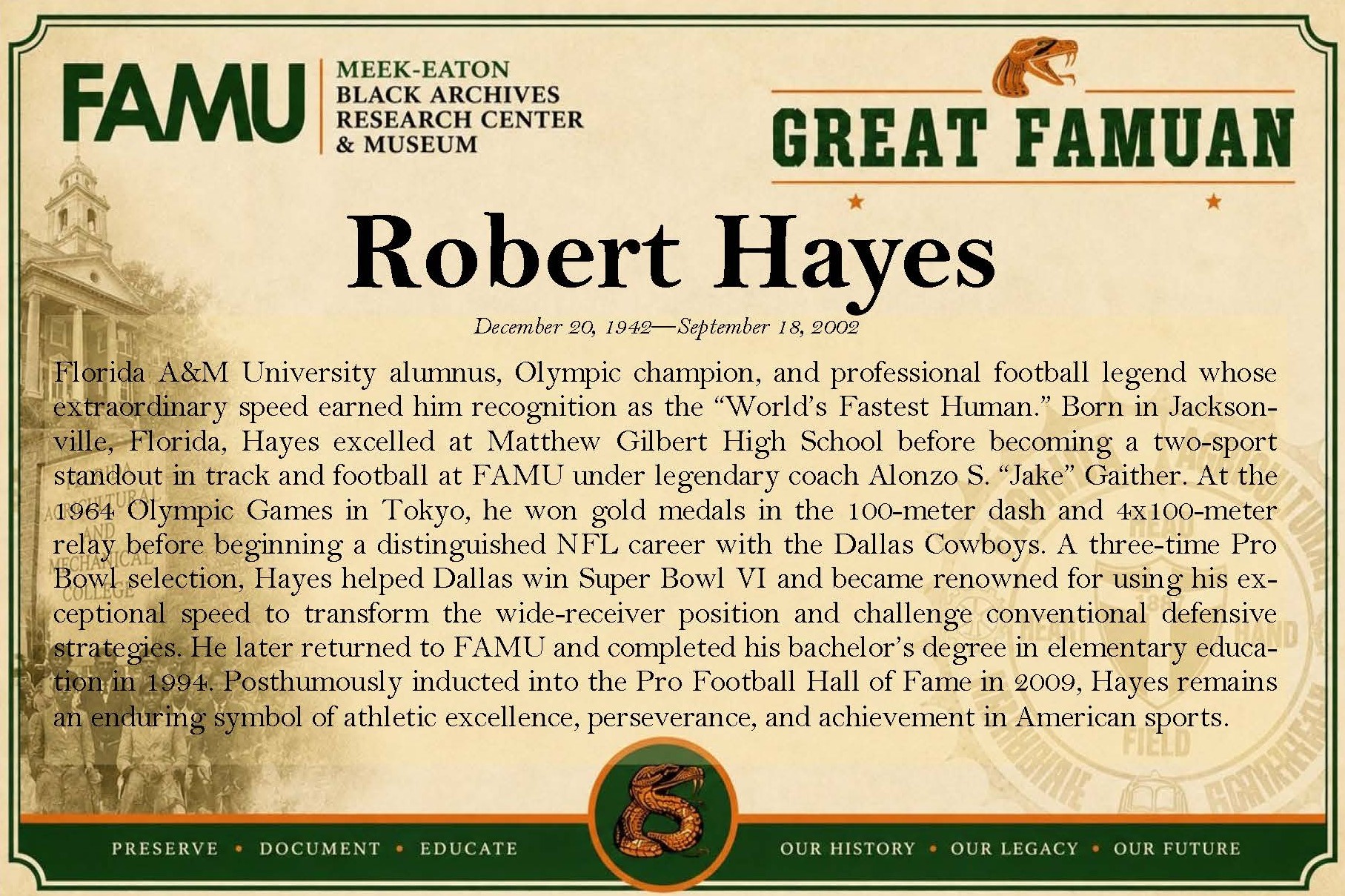
One of Florida A&M University’s most celebrated student-athletes, leaving an extraordinary legacy in both track and football. Arriving at FAMU in the early 1960s, Hayes joined an institution with a nationally respected tradition of Black collegiate athletics. From 1961 to 1964, he represented the Rattlers as a two-sport athlete, combining exceptional sprinting ability with remarkable talent on the football field.
In football, Hayes played split end under legendary head coach Alonzo S. “Jake” Gaither, whose disciplined and innovative program made FAMU a national powerhouse in Black college football. Hayes’s extraordinary acceleration and speed made him a formidable offensive threat and demonstrated the potential of using elite track speed within the passing game—a skill that would later distinguish his professional football career.
Hayes achieved even greater prominence as a member of FAMU’s track and field program. During his collegiate career, he developed into one of the world’s premier sprinters and earned the celebrated designation “World’s Fastest Human.” In 1962, he became the first sprinter to break the six-second barrier in the 60-yard dash with a time of 5.9 seconds. The following year, he recorded a world-record performance of 9.1 seconds in the 100-yard dash.
His accomplishments brought significant national and international attention to Florida A&M at a time when athletes from historically Black colleges and universities often competed for recognition within a segregated or recently integrating American sports culture. Hayes’s success demonstrated the exceptional athletic talent being cultivated at FAMU and strengthened the University’s reputation as a training ground for athletes capable of competing at the highest levels.
Hayes’s FAMU career ultimately carried him to the international stage. While a Rattler, he represented the United States at the 1964 Olympic Games in Tokyo, where he captured gold medals in both the 100-meter dash and the 4x100-meter relay. His Olympic triumphs transformed the FAMU student-athlete from Jacksonville into an internationally recognized champion and forever connected Florida A&M with one of the most celebrated sprinting performances of his generation.
Following the Olympics, Hayes transitioned to professional football, where his world-class speed helped him build a distinguished career with the Dallas Cowboys. Yet his relationship with Florida A&M remained an important part of his personal story. Decades after leaving the University for professional athletics, Hayes returned to FAMU to complete his undergraduate education, earning his bachelor’s degree in elementary education in 1994.
His decision to return and complete his degree added an important dimension to his legacy as a Rattler. Having already achieved Olympic and professional athletic distinction, Hayes demonstrated that educational accomplishment remained worthy of pursuit regardless of age or previous success. He subsequently encouraged younger athletes to value education and to recognize the importance of completing their academic preparation.
Hayes’s life at Florida A&M therefore represents more than an extraordinary athletic record. FAMU provided the collegiate environment in which his talents in track and football reached national and international prominence, while Hayes, in turn, brought exceptional visibility to the University. His journey from the Rattler athletic fields to Olympic gold and professional football—and ultimately back to FAMU to complete his degree—established an enduring relationship between athlete and institution.
Within the history of Florida A&M University, Robert Lee “Bullet Bob” Hayes stands as a powerful example of athletic excellence, perseverance, and Rattler pride. His achievements helped elevate the national profile of FAMU athletics, while his eventual return to complete his education reinforced a legacy extending beyond speed and championships. He remains one of the most consequential student-athletes in the University’s history and an enduring representative of FAMU’s tradition of developing excellence on the field, on the track, and beyond.
-
Life Bio
-
Olympic champion and professional football legend whose extraordinary speed made him one of the most versatile athletes in American sports history. Born and raised in Jacksonville, Florida, Hayes developed his athletic abilities at Matthew Gilbert High School, where he became a standout football player. In 1958, he was a member of Gilbert’s undefeated 12–0 football team, which captured the Black high school state championship during an era when segregation shaped educational and athletic competition throughout the South.
Hayes achieved international prominence at the 1964 Olympic Games in Tokyo, where he won the gold medal in the 100-meter dash and established himself among the world’s premier sprinters. He earned a second gold medal as the anchor of the United States 4x100-meter relay team, delivering a celebrated performance that helped the American team establish a world record. His exceptional accomplishments earned him widespread recognition as the “World’s Fastest Human.”
Following his Olympic triumph, Hayes entered professional football with the Dallas Cowboys in 1965. His unprecedented combination of acceleration and sustained speed made him one of the National Football League’s most dangerous receiving threats. Opposing defenses were compelled to account for his ability to stretch the field vertically, and his presence contributed to changes in the ways defensive teams approached coverage of exceptionally fast wide receivers.
Hayes developed into an accomplished professional receiver rather than simply a track star playing football. During his career, he earned three consecutive Pro Bowl selections and became an important component of the Dallas Cowboys’ emergence as a leading NFL franchise. He helped the Cowboys capture Super Bowl VI in 1972, adding professional football’s highest team honor to an athletic résumé that already included two Olympic gold medals.
Over eleven NFL seasons with the Dallas Cowboys and a final season with the San Francisco 49ers, Hayes recorded 371 receptions for 7,414 receiving yards and 71 receiving touchdowns. His career demonstrated that world-class sprinting speed could be successfully integrated into professional football through route running, receiving ability, athletic instincts, and an understanding of defensive coverage.
Hayes’s life beyond competition also included periods of personal difficulty, experiences that he later used to encourage young people to make responsible choices. He spoke about the dangers of substance abuse and emphasized the importance of education, personal discipline, and preparing for life beyond athletics. This aspect of his later life added a dimension of reflection and mentorship to a public identity initially defined by extraordinary athletic achievement.
Hayes died in his hometown of Jacksonville on September 18, 2002, at the age of fifty-nine. Recognition of his accomplishments continued after his death, culminating in his posthumous induction into the Pro Football Hall of Fame in 2009. His professional legacy rests not simply upon statistics and championships but upon the distinctive manner in which his speed influenced the game of football.
From segregated high school athletics in Jacksonville to the Olympic stage and professional football, Robert Lee “Bullet Bob” Hayes achieved distinction across multiple arenas of American sport. His two Olympic gold medals, professional football championship, and Hall of Fame career established him as a singular figure whose athletic versatility remains exceptional. His life represents a remarkable intersection of speed, competition, perseverance, and athletic innovation, securing his enduring place in both Olympic and professional football history.
-
Artifact Dimensions
-
Black Frame: L × W: 40.64 × 33.02 cm
Gold Frame: L × W: 43.18 × 33.02 cm
-
Medium
-
Printed photograh Black frame with silver trim & Gold painted wood frame
-
Rights
-
All rights reserved. The use of any part of these objects and photographs transmitted in any form by any means, electronic, mechanical, photocopying, recording, or otherwise, or stored in a retrieval system without the prior written consent of Meek-Eaton Black Archives is an infringement of the copyright law.
-
Rights Holder
-
Meek - Eaton Southeastern Regional Black Archives Research Center and Museum