-
Title
-
Genevieve Wheeler
-
Alternative Title
-
Genevieve Josephine Wheeler-Thomas
-
Category
-
Education
-
Affiliation to FAMU
-
Faculty
-
Life at FAMU
-
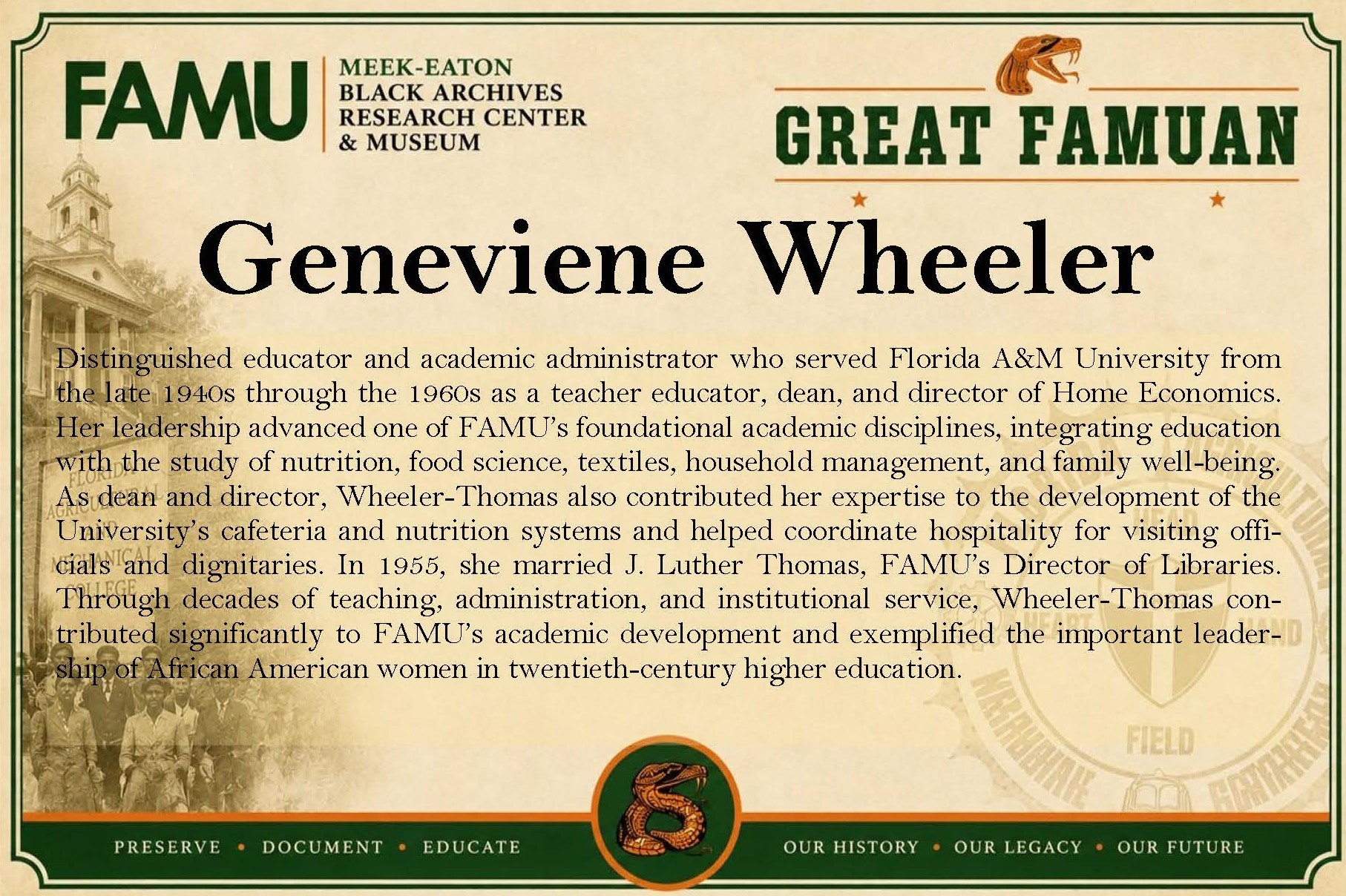
Distinguished educator and academic administrator whose decades of service to Florida Agricultural and Mechanical College—later Florida A&M University—helped strengthen Home Economics as an important field of professional and scientific education. From the late 1940s through the 1960s, she served the institution in increasingly significant capacities as a teacher educator, dean, and director, contributing to FAMU during a transformative period of academic expansion and institutional development.
Home Economics held a particularly important place in Florida A&M's educational history. The discipline was among the institution's foundational areas of collegiate study and developed alongside agriculture as part of FAMU's historic land-grant mission. While agricultural education applied science and technology to the cultivation and production of food and other resources, Home Economics applied scientific, economic, and managerial principles to nutrition, clothing and textiles, household administration, family welfare, and community life.
Wheeler-Thomas helped advance this mission as a teacher educator. Her responsibilities connected the University's academic program with the preparation of professionals who could carry their knowledge into schools and communities throughout Florida and beyond. Graduates trained in Home Economics could pursue careers as teachers, nutrition and food-service professionals, extension educators, administrators, and community leaders.
As Wheeler-Thomas progressed into administrative leadership, first as dean and later as director, her influence extended beyond individual courses and students. She participated in the broader development of the Home Economics program, helping shape curriculum, faculty activity, professional preparation, and the academic direction of the discipline.
Her leadership coincided with one of the most consequential periods in FAMU's twentieth-century history. She witnessed the institution's transition from Florida Agricultural and Mechanical College to Florida Agricultural and Mechanical University in 1953, a change that reflected the expanding scope and complexity of its academic mission.
Wheeler-Thomas's professional expertise also extended into the practical operation of the University. As a leader in Home Economics, she contributed to the planning and development of FAMU's cafeteria and institutional nutrition systems. This work drew upon principles of nutrition, food preparation, sanitation, budgeting, management, and institutional food service and demonstrated how academic expertise could directly support student welfare and campus life.
She likewise played an important role in institutional hospitality. Wheeler-Thomas helped organize and host events for visiting officials and dignitaries, responsibilities that required careful attention to protocol, menu planning, presentation, etiquette, and service. Such occasions were significant opportunities for the University to present its academic standards and institutional identity to distinguished visitors and external stakeholders.
Her service must also be understood within the history of African American women in higher education. During an era when racial and gender discrimination restricted professional advancement in many American institutions, historically Black colleges and universities provided important spaces in which Black women could exercise intellectual and administrative leadership. As a dean and director, Wheeler-Thomas belonged to this important tradition of women who helped shape HBCU academic programs and institutional life.
Her personal connection to the FAMU community deepened in 1955 when she married J. Luther Thomas, then Director of Libraries at Florida A&M. Together, Wheeler-Thomas and Thomas represented two important dimensions of the University's academic infrastructure: she through Home Economics, teacher preparation, and institutional administration, and he through the development and leadership of the University's library resources.
Genevieve Josephine Wheeler-Thomas's legacy at Florida A&M extends beyond her formal titles. She helped advance an academic discipline, prepare generations of educators, strengthen campus nutrition and food-service operations, and contribute to the University's traditions of hospitality and institutional representation.
Her career demonstrates the broad responsibilities assumed by women educators and administrators in the development of historically Black higher education. Through teaching, academic leadership, institutional planning, and student service, Wheeler-Thomas contributed to FAMU's transformation into a comprehensive university and helped establish professional foundations that influenced generations of students.
Her place in FAMU history is therefore that of both **educator and institution builder**. Through sustained academic and administrative leadership, Genevieve Josephine Wheeler-Thomas helped strengthen the University's educational mission while advancing the professional preparation, health, and well-being of the communities FAMU was established to serve.
-
Life Bio
-
Accomplished educator, teacher educator, academic administrator, and specialist in Home Economics whose professional career reflected the expanding opportunities and responsibilities of African American women in twentieth-century higher education. Her work encompassed teaching, educational administration, nutrition, food-service planning, institutional management, hospitality, and the professional preparation of future educators.
Wheeler-Thomas built her career during a period when Home Economics was developing into an increasingly sophisticated interdisciplinary profession. Although historically associated with domestic education, collegiate Home Economics incorporated scientific and professional study in nutrition, chemistry, food preparation and preservation, textiles and clothing, household economics, sanitation, child and family development, consumer education, and institutional management.
For African American women, professional training in Home Economics offered important pathways into careers in education, public service, nutrition, extension work, institutional food service, and administration. These opportunities carried particular significance during segregation, when Black women encountered substantial barriers to professional education and employment.
Wheeler-Thomas emerged as a leader within this professional environment. As a teacher educator, she participated in preparing students not merely to master the subject matter of Home Economics but also to communicate that knowledge effectively in classrooms and communities. Her work consequently had a multiplying influence: educators trained under programs she helped lead could subsequently serve generations of students.
Her progression into senior academic administration reflected the breadth of her professional expertise. As a dean and director, Wheeler-Thomas assumed responsibilities extending beyond classroom teaching into curriculum development, faculty leadership, student preparation, program administration, and institutional planning.
Her expertise in nutrition and household management also translated naturally into institutional food service. The operation of a large educational dining program required knowledge of nutritional science, sanitation, menu development, purchasing, budgeting, personnel management, food preparation, equipment, and efficient service. Wheeler-Thomas's participation in cafeteria and nutrition planning illustrates the practical application of her academic discipline.
Hospitality represented another dimension of her professional responsibilities. Her involvement in hosting officials and distinguished visitors drew upon the traditions of etiquette, food service, event management, and institutional presentation that formed part of professional Home Economics education during the period.
These responsibilities demonstrate that Wheeler-Thomas's professional identity cannot be reduced to the traditional image of domestic instruction. She was an academic administrator applying scientific and managerial principles to complex educational and institutional environments.
Her career is also significant within the history of Black women's professional leadership. African American women educators were central to the development of schools, colleges, families, and community institutions throughout the twentieth century. They served not only as classroom teachers but also as department heads, deans, administrators, mentors, extension educators, and advocates for community well-being.
Wheeler-Thomas belonged to this tradition of educational leadership. Her advancement to dean and director demonstrated the professional authority Black women exercised within historically Black institutions even during decades when opportunities for comparable administrative leadership remained restricted elsewhere.
In 1955, Genevieve J. Wheeler married J. Luther Thomas, a fellow educator and academic administrator who served as Director of Libraries at Florida A&M University. Their marriage joined two professionals whose careers were deeply connected to higher education and the intellectual development of students.
Their professional lives reflected the important role played by African American educators and administrators in strengthening historically Black institutions during the mid-twentieth century. Such professionals frequently understood their work as extending beyond employment to encompass mentorship, institutional stewardship, community advancement, and the creation of opportunities for subsequent generations.
Wheeler-Thomas's professional legacy is consequently multifaceted. She was an educator who prepared students for professional careers; a teacher educator whose influence extended into classrooms beyond her own; an administrator who helped guide an established academic discipline; and a specialist whose expertise in nutrition and management could be applied to institutional operations.
Her career also illuminates the historical evolution of Home Economics itself. The discipline brought scientific inquiry into subjects directly affecting everyday human life, emphasizing the relationship among nutrition, economics, health, education, family, and community welfare. Professionals such as Wheeler-Thomas helped establish these subjects as legitimate areas of collegiate study and professional expertise.
Genevieve Josephine Wheeler-Thomas should therefore be remembered as an educator and administrator whose professional accomplishments reflected both disciplinary expertise and institutional leadership. Her career demonstrates how African American women educators used higher education as a platform for professional advancement, student mentorship, institutional development, and community service.
Through teaching, administration, nutrition, institutional planning, and professional preparation, Wheeler-Thomas contributed to a broader twentieth-century movement that understood education as a means of strengthening individuals, families, and communities. Her life and work stand as an important example of Black women's intellectual and administrative leadership in American higher education.
-
Artifact Dimensions
-
L X W: 44.5 x 36.83sm
-
Medium
-
Photograph, Gold painted wood frrame with gray trim border
-
Rights
-
All rights reserved. The use of any part of these objects and photographs transmitted in any form by any means, electronic, mechanical, photocopying, recording, or otherwise, or stored in a retrieval system without the prior written consent of Meek-Eaton Black Archives is an infringement of the copyright law.
-
Rights Holder
-
Meek - Eaton Southeastern Regional Black Archives Research Center and Museum